Edit this page on GitHub (opens in a new tab)
Zcash launched on October 28, 2016, with the Sprout shielded pool.
Current status. Since NU7 activated on November 6, 2026 (block 3,543,405), ZEC still in the Sprout pool cannot be spent. If you hold funds there, see What happened to Sprout in 2026 and Recovering funds.
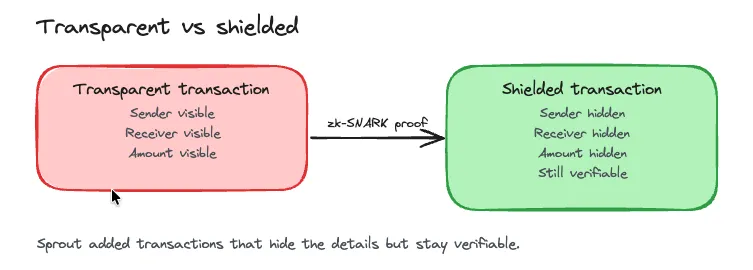
Sprout is the original launch of the Zcash network, not a later network upgrade. It went live at the genesis block on October 28, 2016. No numbered ZIP defines Sprout: the ZIP process started later with Overwinter, so Sprout is described by the original Zcash Protocol Specification and the Zerocash construction it was built on. The Electric Coin Company (then the Zerocoin Electric Coin Company), led by Zooko Wilcox, built and shipped it. Sprout introduced the first practical zk-SNARK shielded transactions and the original shielded pool, so people could send ZEC with the sender, receiver, and amount hidden while the network still checked that the balances added up. The name signaled a young, budding chain that the team expected to grow.
| Launched | Genesis block, October 28, 2016 (07:56 UTC) |
| Also called | Zcash's original shielded pool, consensus branch id 0 |
| Defined by | The original Zcash Protocol Specification and the Zerocash construction (no ZIP number) |
| Built by | Electric Coin Company, led by Zooko Wilcox |
| Trusted setup | The Ceremony: six participants, public parameters kept, toxic waste destroyed |
| New deposits | Stopped at Canopy (November 18, 2020) |
| Since NU7 | Unspendable (November 6, 2026). About 12,224 ZEC remained, according to ZecStats |
Every public blockchain before Sprout put your payments on display: anyone could see who paid whom and how much. Sprout was the first live, permissionless network to hide those details and still prove no one was cheating. That matters for ordinary financial privacy, the kind you expect from cash or a bank statement no one else can read. It also proved that strong on-chain privacy could work in practice, beyond a paper design. The trusted-setup Ceremony that made it possible became a reference point for later cryptography work, and the slow, memory-heavy proving system Sprout shipped with is exactly what pushed the team to build Sapling two years later.
Sprout created two kinds of addresses. Transparent addresses (t-addresses) work like Bitcoin, with the details visible on the public ledger. Shielded addresses (z-addresses) send funds into the Sprout , where the sender, the receiver, and the amount stay hidden. The trick is , zero-knowledge proofs that let a transaction show it is valid, with no double spend and balances that add up, without revealing any of the details. Sprout was the first time this ran in production on a live cryptocurrency.
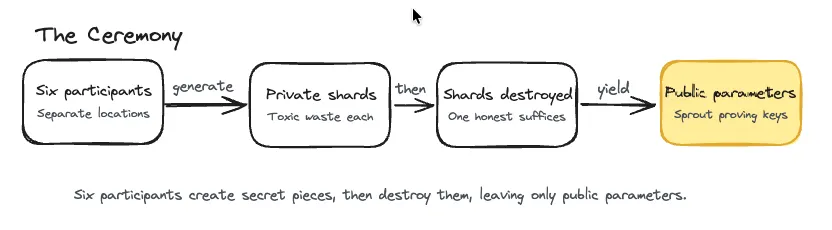
The zk-SNARKs in Sprout needed a set of public parameters, and generating them safely required a one-time setup called the Ceremony. Six participants in separate, distant locations each generated a secret piece, called toxic waste. If anyone ever reassembled all the pieces, they could forge ZEC out of nothing. The design turned that risk into a simple rule: as long as at least one participant destroyed their piece, the full secret could never be rebuilt, so counterfeiting stayed impossible. The participants who have been named publicly include Zooko Wilcox, Andrew Miller, Peter Van Valkenburgh, Peter Todd, and Derek Hinch of NCC Group. One participant chose to stay anonymous.
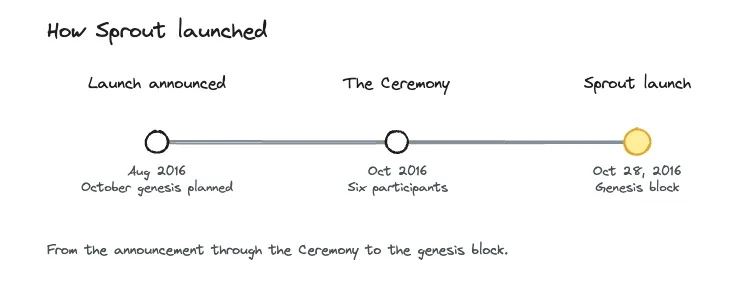
Sprout is the baseline that every later change builds on. When the network-upgrade mechanism arrived with Overwinter, it labeled the original rules as consensus branch id 0, which simply means no upgrade has been applied yet. Everything since then (Overwinter, Sapling, Blossom, Heartwood, Canopy, NU5, NU6, and onward) sits on the chain Sprout started. The launch was announced in August 2016 for an October 28 genesis, the Ceremony ran in the weeks before, and the genesis block's hardcoded timestamp reads October 28, 2016, at 07:56 UTC.
Sprout stopped taking new value when activated in 2020. NU7 then closed the last way to spend what remained.
Those coins are unspendable under the current rules, even for someone with the right keys. They are not burned and stay in the issued supply. ZIP 2003 leaves open the possibility of restoring access in a future upgrade, but warns that spending may never be re-enabled. Sean Bowe has proposed a recovery system in which owners prove ownership and move funds into a supported pool, and no recovery mechanism has been approved. Sprout addresses start with "zc", which helps when checking old wallet records.
| Term | Plain-English meaning |
|---|---|
| zk-SNARK | A zero-knowledge proof that shows a transaction is valid without revealing the sender, receiver, or amount |
| Shielded pool | The private side of Zcash where amounts and parties are hidden. The Sprout pool was the first one |
| z-address and t-address | A z-address is shielded and keeps details private. A t-address is transparent and shows details on the public ledger |
| The Ceremony | The 2016 multi-party setup that generated Sprout's public parameters and then discarded the toxic waste |
| Toxic waste | The secret key pieces from the Ceremony that had to be destroyed so ZEC could not be forged |
| Consensus branch id 0 | The label for Sprout's rules, meaning the baseline before any network upgrade |
Only if you still hold ZEC in the Sprout pool. NU7 made that ZEC unspendable on November 6, 2026. ZEC in newer pools is not affected, and your privacy there depends on the wallet and pool you use now.
Not today. No recovery mechanism has been approved. ZIP 2003 leaves open restoring access in a future upgrade but warns it may never happen, and Sean Bowe has proposed a recovery system. The coins are not burned.
The ZIP process began later, with the Overwinter upgrade. Sprout is the original launch, described by the Zcash Protocol Specification and the Zerocash construction it was based on. ZIP 200 only mentions Sprout in hindsight, as consensus branch id 0, the baseline before any upgrade.
The setup was built so you only needed one of them to be honest. Each held a secret piece, and as long as a single participant destroyed theirs, the full secret could never be rebuilt and no one could forge ZEC. Five participants have been named publicly and one stayed anonymous.
Probably not. Sprout was the first shielded pool, but later upgrades such as Sapling introduced a faster shielded design, and most wallets use newer pools today. Sprout still matters as the work that proved private, verifiable transactions could run on a live network.
Bitcoin puts every payment on a public ledger where amounts and addresses are visible. Sprout added shielded transactions that hide the sender, receiver, and amount while still letting the network confirm the transaction is valid. It kept transparent addresses too, so both styles live on the same chain.
Sprout is often called a network upgrade with an activation height. Why is that not quite right?
Sprout is the original launch of Zcash, not a later upgrade. It has been active since the genesis block (block 0) on October 28, 2016, so there is no activation height to point to. The network-upgrade mechanism came later and labeled Sprout's rules as consensus branch id 0, the baseline before any upgrade.
Series: · Next: