Edit this page on GitHub (opens in a new tab)
Canopy went live on Zcash mainnet at block 1,046,400 (November 18, 2020 UTC).
Historical record. This page describes Canopy as it was when it activated on November 18, 2020. Later network upgrades may have changed these rules. For the current state, see Network Upgrades.
Canopy is Zcash's fifth network upgrade, also labeled Network Upgrade 4 (NU4). It is deployed by ZIP 251, and it activated at mainnet block 1,046,400 on November 18, 2020 (UTC), the same moment as Zcash's first block reward halving. Canopy was mainly a governance and monetary upgrade. It ended the original founders reward and started the new Zcash Development Fund, which pays the Electric Coin Company, the Zcash Foundation, and independent grant recipients. The policy behind that fund came out of an extended community governance process in 2019.
| Activated | Mainnet block 1,046,400, November 18, 2020 (UTC) |
| Also called | Network Upgrade 4 (NU4), Zcash's fifth network upgrade |
| Deployed by | ZIP 251 |
| Main change | Founders reward replaced by the Development Fund |
| Fund share | 20% of each block reward; miners keep 80% |
| Fund split | 35% Bootstrap (ECC), 25% Zcash Foundation, 40% Major Grants |
| Sprout pool | No new value can be added from this block on. Since NU7 (November 6, 2026), ZEC still in it is unspendable |
Zcash funds its own development from block rewards, because it has no company behind it. The founders reward that paid for its early years was set to end at the first halving. Canopy was the replacement: it routed a fixed share of each block reward into a Development Fund and set who receives it. That model was refined by later upgrades, up to .
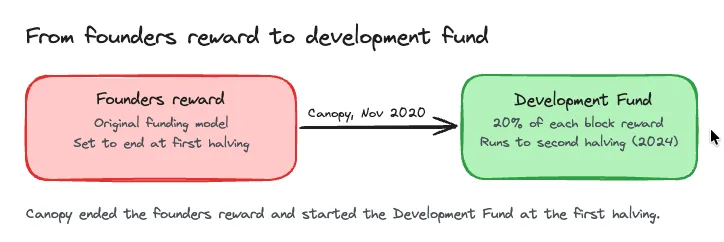
Canopy ended the original founders reward and replaced it with the Zcash Development Fund. The change landed at the same block as Zcash's first halving, when the block reward dropped from 6.25 ZEC to 3.125 ZEC. So miners saw their reward cut in half on the same day a new slice of that smaller reward started flowing to development.
The fund was set to run for four years, from this first halving in November 2020 until the second halving in 2024. The agreed policy was written up as ZIP 1014. The consensus machinery that actually moves the money is the funding stream mechanism: ZIP 207 introduced the general way to direct part of the block subsidy to defined recipients, and ZIP 214 set the specific rules and recipient addresses for the Development Fund.
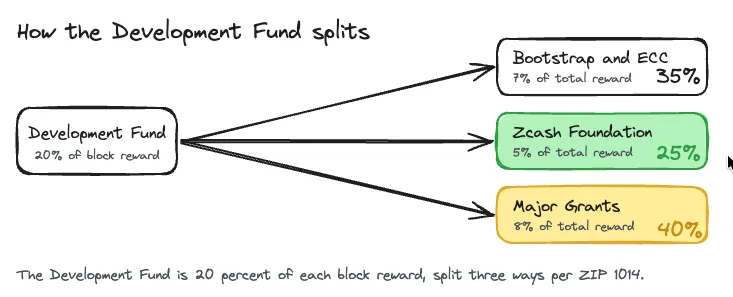
The Development Fund takes 20 percent of each block reward. Miners keep the other 80 percent. That 20 percent is then split three ways, following ZIP 1014.
Measured against the whole block reward instead of just the fund, those shares work out to 7 percent for the Electric Coin Company, 5 percent for the Zcash Foundation, and 8 percent for Major Grants. Both ways of describing it are the same numbers.
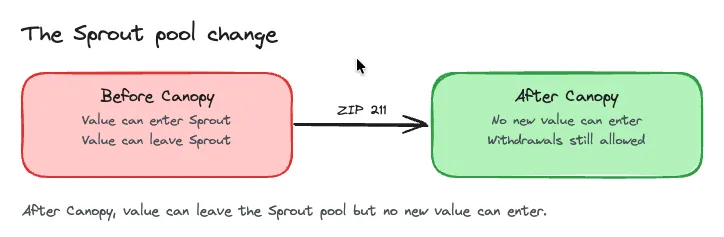
Canopy also started retiring the oldest shielded pool. Sprout was Zcash's first shielded pool, and Canopy began winding it down through ZIP 211.
From the moment Canopy activated, no new value can be added into the Sprout pool. In technical terms, the vpub_old field of every JoinSplit must be zero. Funds already in Sprout can still be withdrawn, so nobody is locked out, but the pool can only shrink from here. This was a first step toward deprecating the legacy Sprout pool in favor of newer shielded pools. NU7 later made ZEC still in Sprout unspendable; see .
Alongside the funding changes, Canopy carried two smaller technical ZIPs. ZIP 212 changed how a recipient derives the Sapling ephemeral secret, deriving it from the note plaintext. ZIP 215 wrote down explicit rules for validating Ed25519 signatures, so every node agrees on exactly which signatures count as valid.
Zcash funds its own development from block rewards because no company stands behind it. The founders reward covered the early years and was scheduled to end at the first halving, so a replacement had to exist before that deadline. Canopy was that replacement: ZIP 207 introduced the general funding-stream mechanism that directs part of the block subsidy to defined recipient addresses, and ZIP 214 set the specific rules and addresses for the Development Fund. Measured against the whole reward rather than the fund alone, the shares are 7% ECC, 5% Zcash Foundation, and 8% Major Grants — the same numbers described two ways.
Canopy also began retiring Sprout, Zcash's oldest shielded pool: from activation, the vpub_old field of every JoinSplit must be zero, so value can leave Sprout but never re-enter.
Canopy is the moment a startup's founder-salary phase ends and a constitution takes over: from that block on, 20 cents of every dollar the network mints is earmarked for maintenance and split 35/25/40 among three departments. At the same time the legacy warehouse (Sprout) is sealed for new storage — anyone can still collect their goods, but nothing new goes in.
The funding stream is enforced by consensus, not by trust: nodes reject blocks whose coinbase does not pay the defined recipients their defined shares. Canopy deliberately landed on the halving block, so miners saw the reward cut in half at the same moment a new slice of that smaller reward began flowing to development. ZIP 212 changed how the Sapling ephemeral secret is derived (from the note plaintext), and ZIP 215 wrote down explicit Ed25519 acceptance rules so every node validates signatures identically — small changes that removed whole classes of consensus ambiguity.
| Term | Plain-English meaning |
|---|---|
| Founders reward | The original funding model that paid for early Zcash development, scheduled to end at the first halving |
| Development Fund | The 20 percent share of each block reward that Canopy routed to development, running to the second halving |
| Block reward (subsidy) | The new ZEC created and paid out as each block is mined |
| Halving | The scheduled event where the block reward is cut in half |
| Funding stream | The consensus mechanism (ZIP 207) that directs part of the block subsidy to defined recipient addresses |
| Sprout pool | Zcash's original shielded pool, which Canopy stopped accepting new value into |
No. Canopy is about how development is funded, plus a few technical rules. Your balances and your shielded transactions are unaffected.
Canopy activated at the same block as Zcash's first halving, which cut the reward from 6.25 ZEC to 3.125 ZEC. The halving is part of Zcash's monetary policy. Canopy's job was to decide how a share of that smaller reward is used.
It funds the people building Zcash. The money goes to the Electric Coin Company (through the Bootstrap Project), the Zcash Foundation, and Major Grants, which supports independent work.
Not any more. After Canopy you could still withdraw funds already in Sprout, but not add new value. NU7 activated on November 6, 2026 and rejects version 4 transactions, the only format that can spend Sprout, so ZEC left in the pool is now unspendable. See .
No. It was set to run for four years, from the first halving in November 2020 until the second halving in 2024, giving the community time to see how it works before revisiting it.
Canopy set up the three-way funding split and the funding stream machinery. Later upgrades, including NU6 and NU6.1, revisited and reshaped the Development Fund built on top of that foundation.
Canopy activated at the exact same block as Zcash's first halving. Why was that timing chosen, and what would have happened to development funding without Canopy?
The original founders reward was scheduled to end at the first halving. Without Canopy, all of the smaller post-halving block reward would have gone to miners, leaving no protocol-level funding for development. Canopy replaced the founders reward with the Development Fund at that exact block, so funding continued without a gap.
Series: · Previous: · Next: