Edit this page on GitHub (opens in a new tab)
Ironwood activated on Zcash mainnet at block 3,428,143 on July 28, 2026 UTC, and has been live since.
Current upgrade. Wallet migration tools are still changing, so follow your wallet's own guidance.
Ironwood is a Zcash network upgrade, formally NU6.3, that introduces a new shielded pool of the same name. A shielded pool is the set of funds whose amounts and owners stay hidden by zero-knowledge cryptography. Ironwood exists to contain and audit a soundness bug found in the existing Orchard shielded pool, and to give the community a stronger way to check that the total supply of ZEC is honest. Its consensus rules are specified in ZIP 258.
| Activated | Mainnet block 3,428,143, July 28, 2026 (UTC) |
| Formal name | NU6.3, specified in ZIP 258 |
| New pool | Ironwood, with the same receiver structure as Orchard, so existing addresses can direct funds into it |
| Orchard | Spend-only: value can leave it, no new value can enter |
| Notes | Ironwood notes use a quantum-recoverable format (ZIP 2005) |
| Why | A soundness bug in the Orchard circuit, found in late May 2026 (CVE-2026-54496) and fixed in NU6.2 |
| Exploitation | No evidence it was ever exploited, and no change to the total supply |
| Moving value | Gradual. The amount that crosses from Orchard to Ironwood is public |
With transparent money like Bitcoin, anyone can check that no coins were forged by reading the public ledger. Shielded money hides the amounts, so you cannot just look. Instead the cryptography itself has to guarantee that no one can create money in secret. Ironwood matters because a bug was found in that guarantee for the Orchard pool. The upgrade closes the gap and gives anyone a way to confirm that the total supply of ZEC is still honest.
New to Zcash? Start with What is ZEC and Zcash and Shielded Pools, then come back here.
In late May 2026, independent security researcher Taylor Hornby, during a protocol audit for Shielded Labs, responsibly disclosed a soundness bug in the Orchard shielded pool. Orchard was Zcash's newest shielded pool at the time, and the flaw sat in an elliptic-curve part of its zero-knowledge circuit, which uses the Halo 2 proving system.
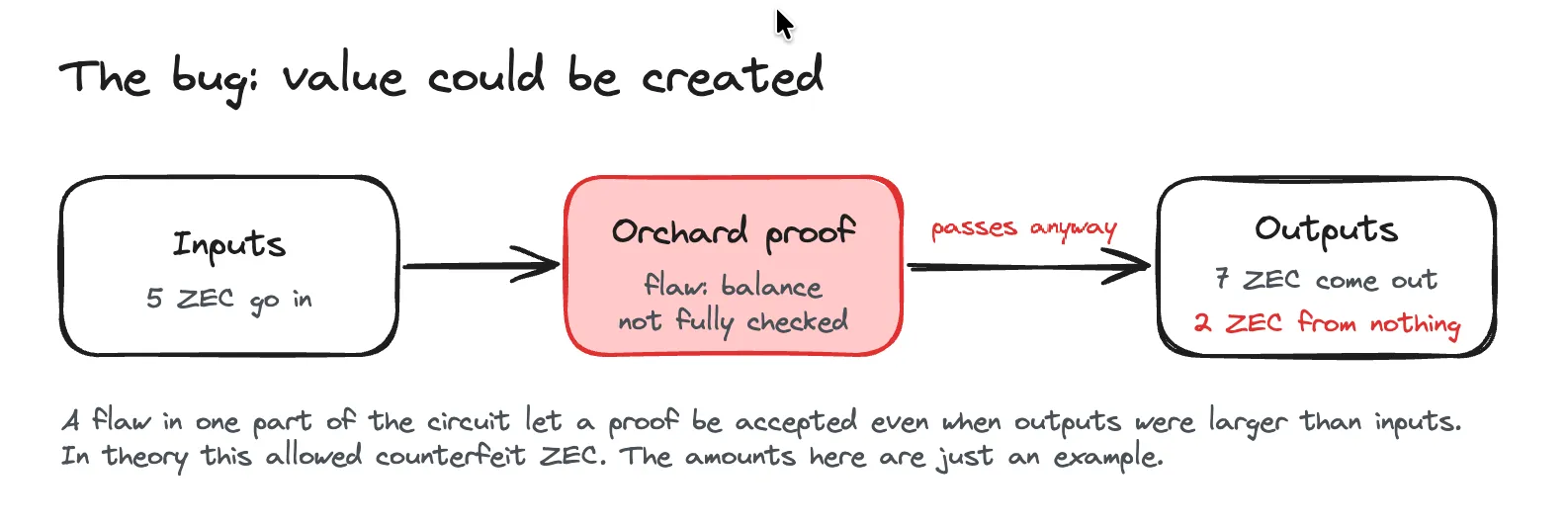
The numbers above are a simplified picture. The real flaw was in a specific piece of the circuit's math, not a literal count of coins going in and out. The point to take away is only that a soundness bug can let value be created inside the pool without detection.
Importantly, there is no evidence the bug was ever exploited, no evidence of impact to user funds, and no evidence that the total supply of ZEC changed. It was found through security research and fixed before any known harm.
The Zcash community shipped fixes in stages rather than all at once.
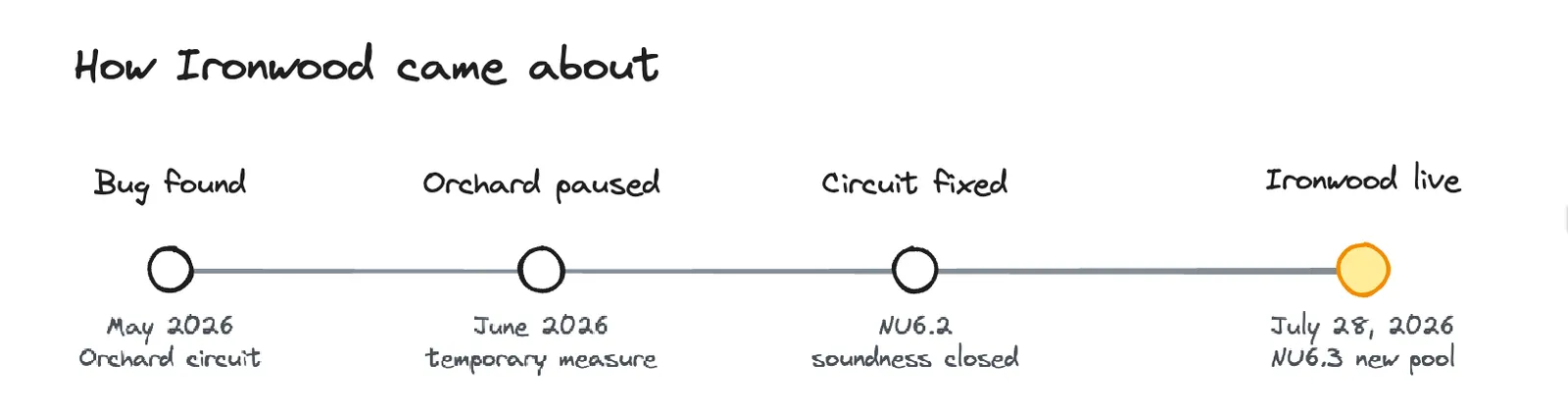
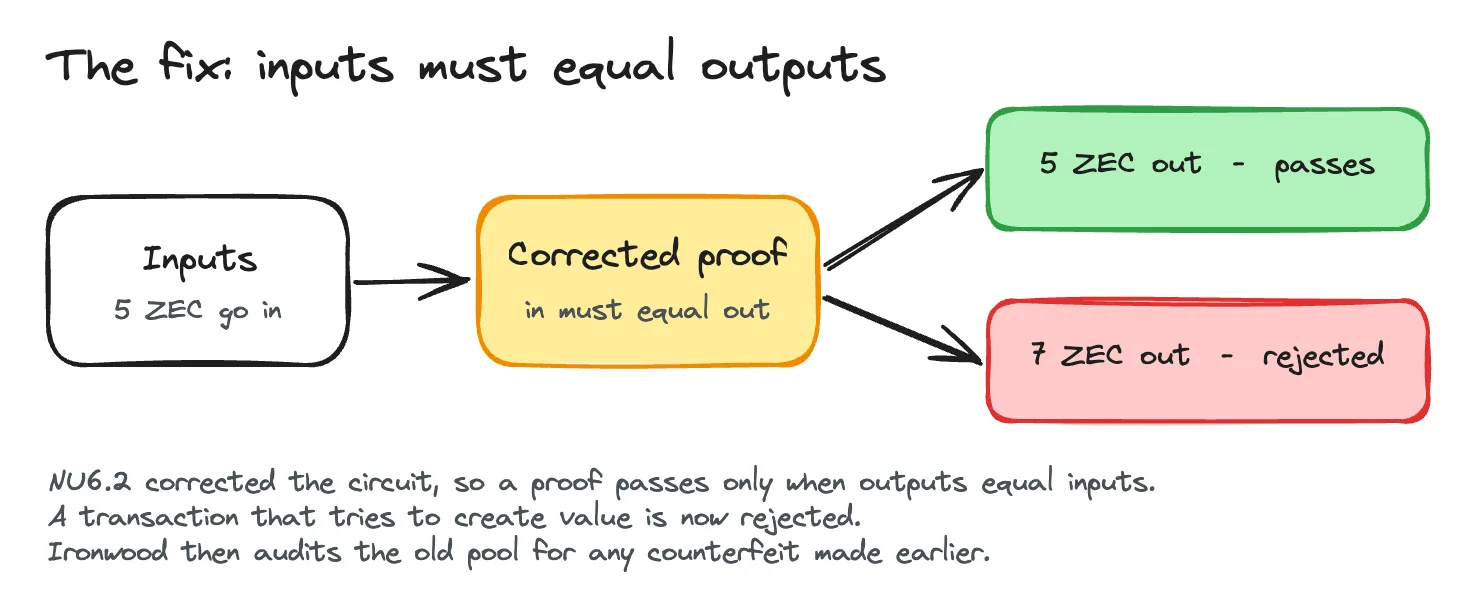
NU6.2 secured the Orchard circuit for all new transactions, but value created under the old rules still sits in the Orchard pool. Ironwood gives that value a clean destination and a way to audit it as it moves.
The Ironwood pool is the shielded value pool created by NU6.3 at block 3,428,143. It is built on the corrected circuit and uses a quantum-recoverable note format (a forward-compatibility measure: if quantum computers ever broke today's elliptic-curve cryptography, it would let the network check that a recovered note matches a real one rather than a forged one. It does not make spending post-quantum secure, and the recovery process itself is not defined yet), defined in ZIP 2005.
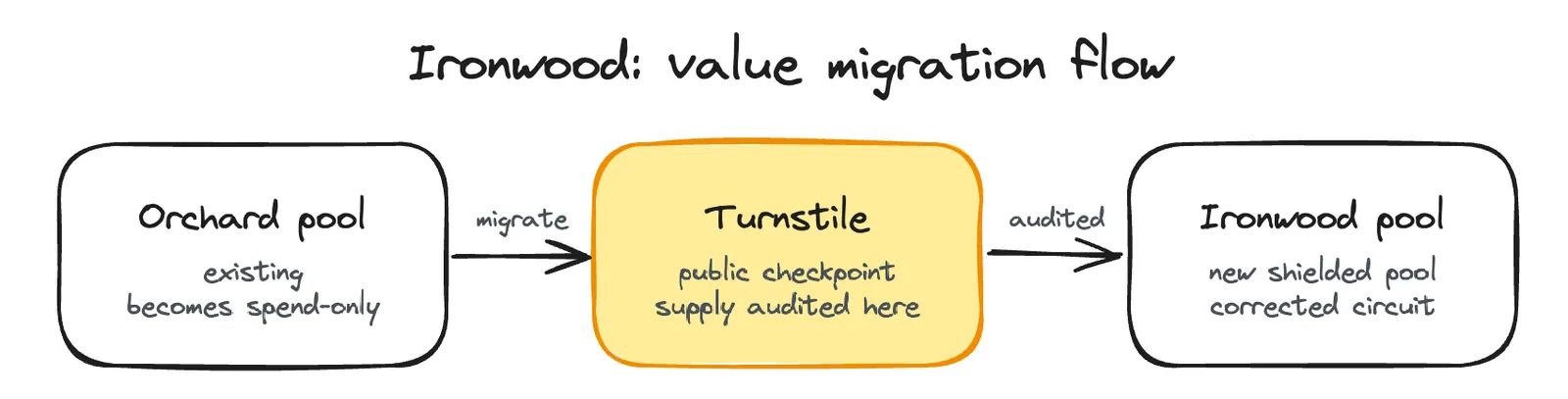
The key idea in Ironwood is the turnstile, an accounting checkpoint that every coin must pass through when moving from the old Orchard pool into Ironwood.
A turnstile does for hidden money what a glass door does for a bank vault. You still cannot see inside, but you can count exactly what goes in and what comes out.
Turnstiles are not new to Zcash. The network has used them before, at the boundaries between the Sprout, Sapling, and Orchard pools, so that value moving between pools stays auditable and no pool can release more than legitimately entered it.
Consensus rules also require that Orchard's value balance can never go negative, which is what stops new value from entering it.
Wallets and node software handle most of this automatically, but the practical shift is simple: over time, move shielded holdings from the old Orchard pool through the turnstile into the Ironwood pool. Each move shows its amount on the blockchain. Some wallets, such as Cake Wallet, split the balance into round amounts and spread the moves over time so they are harder to link. Follow the guidance from your wallet provider, and keep your software on a supported release.
| Term | Plain-English meaning |
|---|---|
| Shielded pool | The set of funds whose amounts and owners are hidden by zero-knowledge cryptography |
| Soundness bug | A flaw that lets an invalid transaction pass the proof check as if it were valid |
| Turnstile | A public checkpoint that counts value moving between pools so the supply stays auditable |
| Spend-only | A pool you can spend from, but cannot add new value to |
| Network upgrade (NU) | A coordinated change to Zcash's consensus rules, activated at a set block height |
| Quantum-recoverable note | A note format that lets the network later check recovered notes against real ones if quantum computers break today's cryptography. The recovery process is not defined yet |
No. There is no evidence the bug was ever used, no impact to user funds, and no change to the total supply.
Keep your wallet and node software on a supported release. Spending Orchard funds moves them into Ironwood, and the amount that crosses is public. Some wallets offer a migration that sends standard amounts over time, so your balance is harder to link. Follow your wallet provider's guidance.
Funds in Orchard stay yours and can leave it by spending, but no new value can enter it. The sources checked for this page give no migration deadline, so check your wallet's guidance.
Yes. Payments inside Ironwood hide sender, receiver, and amount, as Orchard payments did. The amount that moves between pools, such as from Orchard to Ironwood, is public. This upgrade is about supply integrity.
There is no evidence that it was. It was found through security research, responsibly disclosed, and fixed before any known harm.
It becomes spend-only. No new value can enter it, and existing value moves into Ironwood through the turnstile, where the migration is publicly audited.
If the ZEC inside shielded pools is hidden, how can anyone confirm that the Orchard bug did not secretly inflate the total supply?
Through the turnstile. Every coin leaving the old Orchard pool is counted at a public checkpoint as it enters Ironwood. If more value tried to leave than legitimately entered, the accounting would not balance, so any counterfeit the bug could have created would surface at that gate.
Series: Network Upgrades index · Previous: NU6.2 · Next: NU7
