Edit this page on GitHub (opens in a new tab)
NU6 went live on Zcash mainnet at block 2,726,400 (November 23, 2024 UTC).
What you'll take away: how Zcash keeps funding its own development after a halving, why it set aside a reserve it did not yet know how to spend, and how it made the total ZEC supply exactly predictable.
NU6 is a Zcash network upgrade, deployed by ZIP 253, that activated on mainnet in November 2024 at block 2,726,400. It is a monetary and development-funding upgrade: it kept a share of the block subsidy going to development past the November 2024 halving, set up an in-protocol reserve for future community-decided use, and tightened how new ZEC is counted. NU6 was endorsed by both the Electric Coin Company and the Zcash Foundation.
Why this matters. Zcash's Development Fund was scheduled to end around the November 2024 halving, the second in its history. NU6 kept that funding going, but instead of handing every coin to fixed recipients, it reserved a share inside the protocol so the community could decide later what to do with it. It also closed a quiet accounting gap, so the total amount of ZEC that will ever exist can now be predicted exactly.
Think of NU6 as a household that has been paying a fixed allowance to its builders and knows payday is scheduled to end. Instead of stopping payment, NU6 splits the allowance: part continues to the community grants committee, and part goes into a family safe for which no combination has been announced yet. The safe keeps the money set aside until the household later agrees on the rules for opening it — that agreement is NU6.1.
NU6 continued to send 20% of the block subsidy to development funding after the November 2024 halving, a rule defined in ZIP 1015. It split that 20% two ways.
The rest of the block subsidy, plus transaction fees, goes to the miners who secure the network. NU6 also updated the existing funding-stream and dev-fund rules (ZIP 207 and ZIP 214) to fit this new structure.
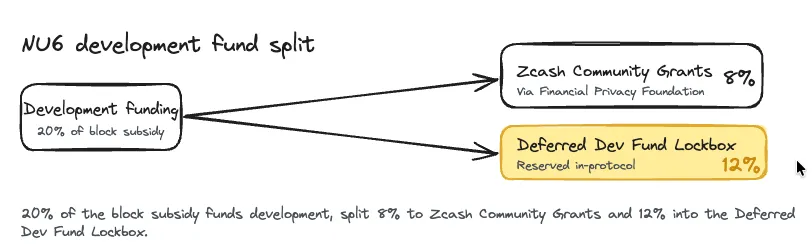
The 12% share is the new idea in NU6. Instead of being paid to a recipient address, that value is deposited directly into an in-protocol pool called the Deferred Dev Fund Lockbox, defined in ZIP 2001.
That question was answered later by NU6.1, which set the governance: it continued the 8% block-subsidy stream to Zcash Community Grants and directed a 12% stream into a coin-holder-controlled fund seeded by the lockbox.
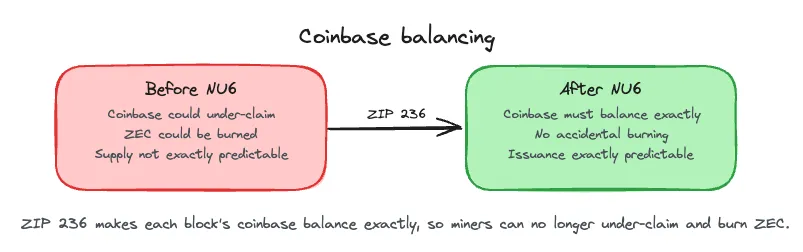
NU6 also closed an accounting gap in how new ZEC is created, defined in ZIP 236. Coinbase transactions are the special transactions that pay out each block's new ZEC and fees.
NU6 is one chapter in a longer story about how Zcash pays for itself.
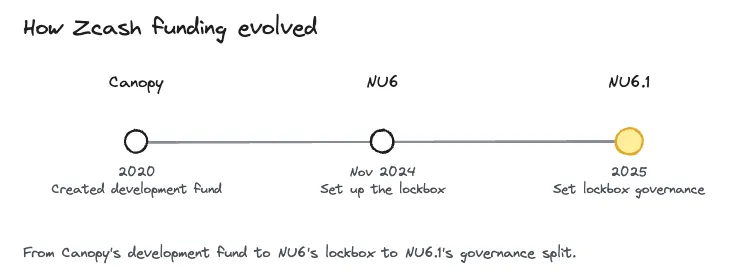
NU6's split was replaced by the model (ZIP 1016): 8% of the block subsidy to Zcash Community Grants and 12% to a coin-holder-controlled fund seeded by the lockbox. Per the NU6.1 page, those rules stay in place until the third Zcash halving.
The model is still being debated. In October 2026 a draft ZIP proposed redirecting the 8% Zcash Community Grants stream to the Network Sustainability Mechanism (ZIP 237). As of October 27, 2026 it was under discussion and no decision had been made (Unchained).
| Term | Plain-English meaning |
|---|---|
| Block subsidy | The new ZEC created with each block that is mined |
| Coinbase transaction | The special transaction that pays out a block's subsidy and fees |
| Deferred Dev Fund Lockbox | An in-protocol reserve that holds a share of issuance for future community-decided use |
| Zcash Community Grants (ZCG) | A committee that funds work by and for the Zcash community |
| Consensus branch id | The identifier nodes use to tell which upgrade's rules a block follows |
| Network upgrade (NU) | A coordinated change to Zcash's consensus rules, activated at a set block height |
Does NU6 change my ZEC or my privacy? No. NU6 is about how development is funded and how issuance is counted, not about your transactions or privacy. Your funds and shielded transactions are unaffected.
Where does the funding come from? From the block subsidy, the new ZEC issued as blocks are mined. A 20% share is routed to development instead of all of it going to miners.
What is the lockbox for? It reserves a share of issuance inside the protocol so the community can decide later how to use it. NU6 set the reserve aside, and NU6.1 set the rules for who controls it.
Does the exact-balance rule change my coins? No. It only requires each block's coinbase transaction to pay out exactly what it is owed. It affects new issuance accounting, not existing balances.
What technically defines NU6? NU6 is deployed by ZIP 253, which sets its mainnet activation at block 2,726,400 and its consensus branch id. The consensus changes themselves come from ZIP 236, ZIP 1015, and ZIP 2001, with ZIP 207 and ZIP 214 updated to fit.
How is NU6 different from NU6.1? NU6 restructured funding and created the lockbox. NU6.1 decided who controls the lockbox funds and how the reserved share is split.
NU6 set up the Deferred Dev Fund Lockbox but did not say who controls it. Why would an upgrade create a reserve and deliberately leave its governance for later?
Creating the reserve locked in that a share of issuance would be set aside inside the protocol instead of paid to fixed recipients. Deciding who controls those funds and how they are released is a harder governance question. NU6 deliberately left that open, and NU6.1 answered it: 8% of the block subsidy continues to Zcash Community Grants, and 12% goes to a coin-holder-controlled fund seeded by the lockbox.
ZIP 253: Deployment of the NU6 Network Upgrade
ZIP 236: Blocks should balance exactly
ZIP 1015: Block Subsidy Allocation for Non-Direct Development Funding
ZIP 2001: Lockbox Funding Streams
| Page | Why it is related |
|---|---|
| Canopy | created the development fund that NU6 restructured |
| NU6.1 | decided who controls the lockbox funds |
| NU6.2 | the Orchard emergency-repair upgrade in the same series |
| Development Fund | the funding history behind the 20% share |
Series: Network Upgrades index · Previous: NU5 · Next: NU6.1