Edit this page on GitHub (opens in a new tab)
NU5 went live on Zcash mainnet at block 1,687,104 (May 31, 2022 UTC).
Historical record. This page describes NU5 as it was when it activated on May 31, 2022. Later network upgrades may have changed these rules. For the current state, see Network Upgrades.
NU5 (Network Upgrade 5) is the sixth Zcash network upgrade, deployed by ZIP 252. It is a major cryptographic upgrade. It introduced the Orchard shielded payment protocol, built on the Halo 2 proving system, along with unified Addresses and a new version 5 transaction format. NU5 shipped in the Electric Coin Company's zcashd v5.0.0 release. zcashd has since been retired; see Full Nodes.
| Activated | Mainnet block 1,687,104, May 31, 2022 (UTC) |
| Also called | Network Upgrade 5, Zcash's sixth network upgrade |
| Deployed by | ZIP 252, shipped in zcashd 5.0.0 |
| Consensus branch id | c2d6d0b4 |
| Main changes | Orchard pool on Halo 2 (ZIP 224), Unified Addresses (ZIP 316), version 5 transactions (ZIP 225) |
| Trusted setup | None for Orchard |
| Since Ironwood | Orchard is spend-only (NU6.3, July 28, 2026) |
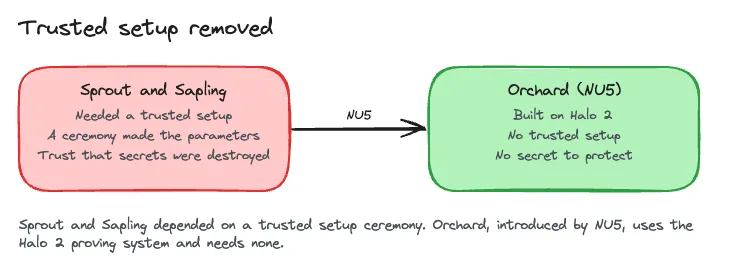
A shielded pool is only as trustworthy as the setup that created it. Zcash's first two shielded pools, Sprout and Sapling, each needed a one-time trusted setup ceremony to generate their secret parameters. If those parameters were ever kept instead of destroyed, someone could have printed counterfeit ZEC without anyone seeing it. NU5's Orchard pool closes that concern by using the Halo 2 proving system, which needs no such ceremony.
Orchard is the shielded protocol introduced by NU5, defined in ZIP 224. It is built on the Halo 2 proving system, which uses a technique called PLONKish arithmetization on the Pallas and Vesta curve cycle. The practical payoff is simple: Halo 2 needs no trusted setup and no structured reference string, so there is no secret parameter to misuse.
Sprout and Sapling both depended on a trusted setup. A group of people ran a ceremony to build each pool's parameters, and everyone had to trust that at least one of them destroyed their piece of the secret. Orchard removes that assumption. The older pools still exist after NU5, so the no-setup guarantee applies to funds you hold in the Orchard pool.
NU5 bundles several consensus changes, all activated together at block 1,687,104.
NU5 also updated a number of existing ZIPs (32, 203, 209, 212, 213, 221, and 401) so they account for the new Orchard pool.
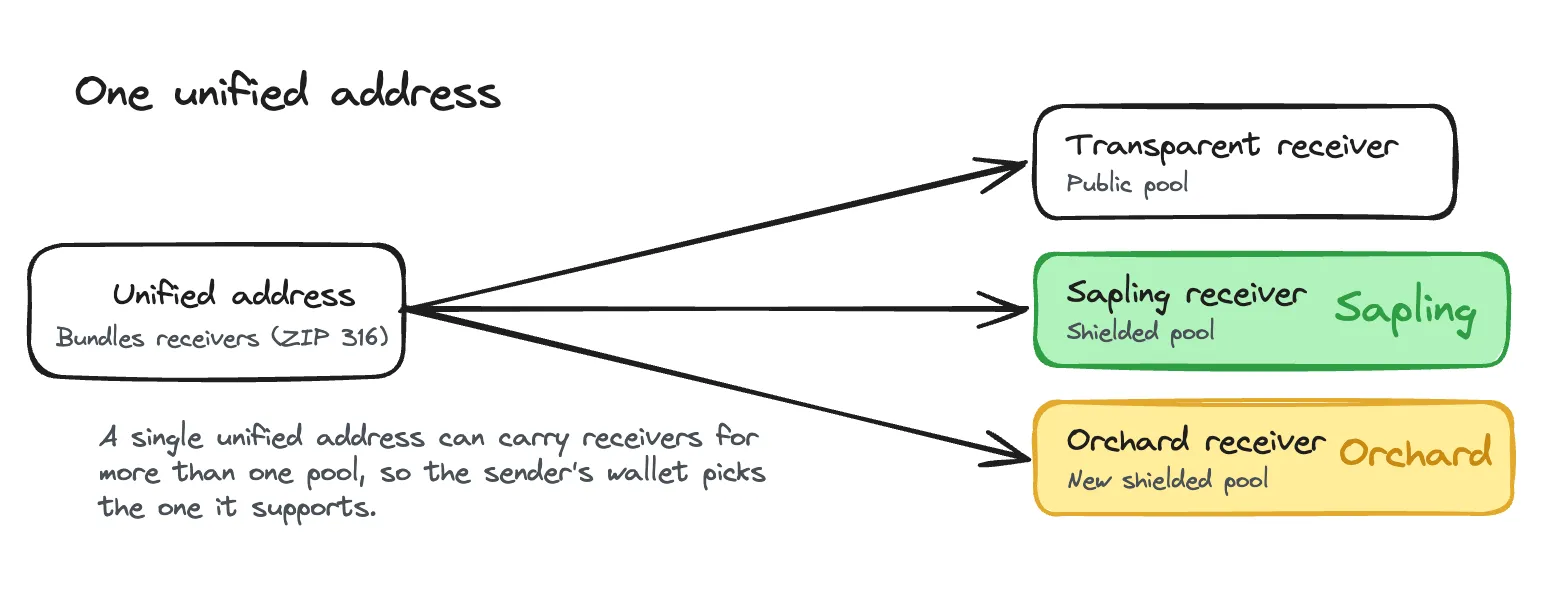
Before NU5, each pool had its own address type, and a sender had to know which kind you wanted. Unified Addresses, defined in ZIP 316, change that. A single Unified Address can bundle receivers for more than one pool, so the sender's wallet just picks the best one it supports.
Unified viewing keys work the same way for viewing. They give read-only visibility across the pools an address covers. For more on that, see the Viewing Keys page.
NU5 followed Zcash's earlier upgrades: Overwinter, Sapling, Blossom, Heartwood, and Canopy. It activated on mainnet on May 31, 2022. Orchard's curve cycle was chosen because it supports recursion, which is groundwork for later scaling work. NU5 is the direct predecessor to the NU6 and NU6.x line of upgrades, which built on the Orchard pool and later patched it.
The trusted-setup problem: Sprout (2016) and Sapling (2018) each required a one-time ceremony to generate secret parameters, and security rested on at least one participant destroying their fragment. If every participant had secretly kept a copy, counterfeit ZEC would have been possible. Orchard removes that assumption entirely: Halo 2 uses no trusted setup and no structured reference string, so there is no secret that could ever be misused.
NU5 bundled several consensus changes, activated together: the Orchard pool (ZIP 224), the version 5 transaction format (ZIP 225), Unified Addresses (ZIP 316), transaction id non-malleability (ZIP 244), canonical Jubjub point encodings (ZIP 216), and peer-to-peer relay of v5 transactions (ZIP 239). It also updated ZIPs 32, 203, 209, 212, 213, 221, and 401 to account for the new pool.
The older pools are like safes whose combination was generated in a one-time group ceremony — you trust that every participant shredded their copy of it. Orchard is a safe whose lock re-verifies itself on every use: there is no ceremony, no master secret, nothing that could have been kept. Unified Addresses are a business card that lists every entrance — transparent, Sapling, Orchard — and the visitor picks the door they can actually open.
Halo 2 uses PLONKish arithmetization on the Pallas and Vesta curve cycle — two pairing-friendly curves that complement each other, which is what enables recursion: proofs that verify other proofs. That recursion is the foundation Zcash's later scaling work builds on. The v5 transaction layout separates transparent, Sapling, and Orchard regions and drops Sprout fields; the older version 4 format remained valid after activation. ZIP 244 recomputes the transaction id from what a transaction does, not from the proofs and signatures that authorize it, closing malleability vectors.
Orchard ran for four years before a flaw surfaced. In late May 2026, researcher Taylor Hornby found a soundness bug in the Orchard circuit: a missing constraint in one gadget (CVE-2026-54496) that had been there since NU5. There is no evidence it was ever exploited.
Unified Addresses keep working, because Ironwood uses the same receiver structure as Orchard. The page covers the bug in more detail.
| Term | Plain-English meaning |
|---|---|
| Network upgrade (NU) | A coordinated change to Zcash's consensus rules, activated at a set block height |
| Orchard | The shielded pool NU5 introduced, built on the Halo 2 proving system |
| Halo 2 | The proving system behind Orchard that needs no trusted setup |
| Trusted setup | A one-time ceremony that makes a pool's secret parameters and must be trusted to destroy them |
| Unified Address | A single address that can bundle receivers for more than one pool (ZIP 316) |
| Consensus branch id | An identifier marking which set of rules a transaction belongs to |
No. NU5 added a new shielded pool and a new address format. Your existing ZEC is unaffected, and your privacy is not reduced. At the time, moving funds into Orchard gave you a pool that needs no trusted setup. Orchard no longer accepts new value since Ironwood (NU6.3), so new shielded funds go to the Ironwood pool.
Orchard is Zcash's shielded protocol introduced by NU5. It runs on the Halo 2 proving system, so it needs no trusted setup ceremony.
No. A supported wallet handles NU5 for you. You can keep using older addresses, and you can start using unified Addresses when your wallet offers them.
A single address that can hold receivers for more than one pool. The sender's wallet picks the pool it supports, so you do not have to hand out a different address for each type.
Not retroactively. Orchard needs no trusted setup, but the Sapling pool's earlier parameters still exist after NU5. The no-setup guarantee applies to funds held in the Orchard pool.
Not at the time. NU5 added the version 5 format, and the older version 4 format stayed valid after activation. NU7 made version 4 transactions invalid when it activated on November 6, 2026 (ZIP 259, which deploys ZIP 2003).
Sprout and Sapling both needed a trusted setup ceremony. What did NU5's Orchard pool change about that, and why does it matter?
Orchard is built on the Halo 2 proving system, which needs no trusted setup and no structured reference string. That removes the risk that leftover secret parameters could ever be used to counterfeit ZEC. The guarantee applies to funds held in the Orchard pool. The older Sapling parameters still exist after NU5.
Series: Network Upgrades index · Previous: Canopy · Next: NU6