Edit this page on GitHub (opens in a new tab)
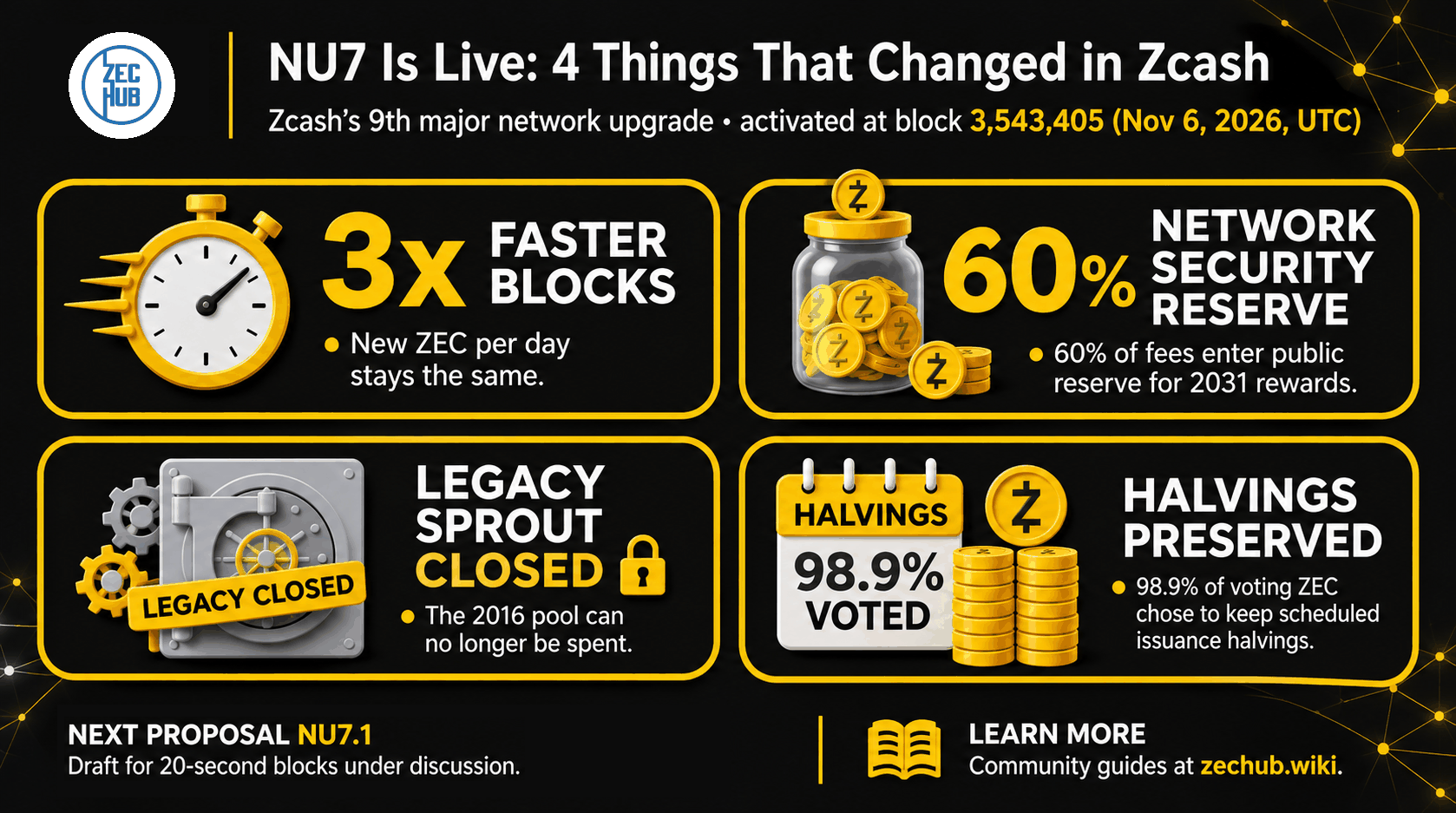
NU7 activated on Zcash Mainnet at block 3,543,405 on November 6, 2026 (02:34 UTC; the evening of November 5 in US time zones), and has been live since.
What you'll take away: what NU7 changed (faster blocks, shielded action limits, fee recycling, the end of version 4 transactions), what it left alone, and what node operators, wallets, exchanges and miners had to do.
NU7 is a Zcash network upgrade, deployed by ZIP 259. It cut the time between blocks from 75 seconds to 25 seconds, capped how many shielded actions fit in one block, started removing 60% of transaction fees from circulation so they can be reissued to future miners, and made version 4 transactions invalid, which retired the old Sprout pool. It did not introduce a new transaction format. Its consensus branch ID is 0x77190ad9.
Why this matters. Before NU7 you waited 75 seconds on average for a first confirmation, which is slow for a shop counter, an exchange deposit or a cross-chain swap. NU7 brought that down to about 25 seconds without printing more ZEC: the reward per block was cut to a third, so daily issuance stayed the same. It is also the first upgrade that adds a mechanism aimed at paying for network security after block rewards shrink.
New to Zcash? Start with What is ZEC and Zcash and Shielded Pools, then come back here.
In plain words: blocks now arrive every 25 seconds, the amount of new ZEC per day stays the same, part of every fee is saved for future miners, and the old Sprout pool is closed.
zcashd release with NU7 support.Think of the chain as a train line. Before NU7 a train left every 75 seconds and could carry as many passengers as fit in 2 MB. NU7 runs a train every 25 seconds, pays each driver a third of the old fare so the daily total is the same, and puts a cap on how many of the heaviest passengers (shielded actions) can board one train, so no single train can take too long to check.
Each block now has a shared budget and per-pool caps:
| Limit | Per block |
|---|---|
| All shielded actions across pools | 330 |
| Orchard actions | 330 |
| Ironwood actions | 330 |
| Sapling inputs + outputs | 300 |
| Sprout JoinSplits | none allowed |
Before NU7, a full 2 MB block could hold about 617 Orchard or Ironwood actions or about 2,107 Sapling outputs, with no per-pool limits. ZIP 218 sets the new caps so that, even with three times as many blocks, the worst case for nodes and for syncing wallets is lower than before (for example, maximum light-client shielded sync bandwidth falls from about 271 to 169 MB per day), while Orchard-protocol throughput more than doubles (about 2.9 to 6.6 transactions per second for 2-action transactions).
state/v28 before upgrading. zcashd has no NU7 release (its latest release is 6.20.0, from June 2026); the Zebra book's zcashd API migration guide maps each zcashd RPC to Zebra, Zallet or its replacement. See Full Nodes and the Hardened Zebra guide.zcashd node can stay online on the old rules and quietly fall off the real chain. Check that your node reports a height above 3,543,405 and matches a block explorer.| Term | Plain-English meaning |
|---|---|
| Block target spacing | The average time between blocks that the difficulty adjustment aims for: 25 seconds since NU7 |
| Block subsidy | The new ZEC created in each block, shared between the miner and the development-fund streams |
| Shielded action | One unit of shielded work in a transaction (an Orchard or Ironwood action, or a Sapling input or output) |
| Network Sustainability Mechanism (NSM) | The rules that take part of the fees out of circulation and reissue them to future miners |
| NSM Value Balance | The public running total of ZEC removed from circulation and waiting to be reissued |
| Version 4 transaction | The transaction format from Sapling, made invalid by NU7; v5 and v6 remain valid |
| Consensus branch ID | The number that identifies a set of consensus rules; signatures commit to it, so a transaction signed for old rules is invalid under new ones |
When did NU7 activate? At Mainnet block 3,543,405 on November 6, 2026 at 02:34 UTC. Testnet activated earlier, at block 4,465,026 on October 4, 2026.
Did the block reward change? Per block, yes: 0.52083333 ZEC instead of 1.5625 ZEC. Per day, no: about 1,800 ZEC either way.
Is my Sprout ZEC gone? It can no longer be moved, because Sprout spends need v4 transactions and those are now invalid. See Recovering Funds for what that means in practice.
Do I need a new wallet? You need a wallet version that supports NU7. ZecHub's Wallets page shows which wallets are NU7 compatible.
When does fee reissuance start? At block 8,939,664 on Mainnet, projected around February 2031 if blocks keep a 25-second average.
Why did NU7 skip a new transaction format? To spare wallets and parsers a second migration right after Ironwood's v6 format, and because the fee split is calculated per block, so no new transaction field was needed.
Answers: (1) the per-block subsidy was cut to a third while blocks became three times as frequent; (2) they go into the NSM Value Balance and are reissued to miners from block 8,939,664; (3) Sprout spends exist only in the v4 format, which NU7 made invalid; (4) ZIP 259 waived the automatic shutdown, so an old node can keep running on the wrong chain.
ZIP 259: Deployment of the NU7 Network Upgrade
ZIP 218: 25-second Block Target Spacing
ZIP 235: Remove 60% of Transaction Fees From Circulation
ZIP 237: Network Sustainability Mechanism: Halving-Preserving Issuance
ZIP 2003: Disallow version 4 transactions
Zcash Community Forum: NU7 Timeline
| Page | Why it is related |
|---|---|
| Ironwood | the previous upgrade in the series, which introduced v6 transactions |
| What 25-Second Blocks Actually Change | a deeper look at the faster block time |
| Sprout | the pool NU7 retired |
| Recovering Funds | what the Sprout freeze means for old funds |
| Transactions | expiry and confirmations after NU7 |
Series: Network Upgrades index · Previous: Ironwood
