Edit this page on GitHub (opens in a new tab)
Si vous découvrez Zcash pour la première fois, vous remarquerez immédiatement qu'il existe deux types de transactions possibles : transparentes et protégées. De plus, si vous suivez les dernières évolutions de l'écosystème Zcash, vous avez peut-être entendu parler des adresses unifiées, ou UA. Lorsque les acteurs du secteur Zcash parlent de transactions protégées, ils désignent des transactions impliquant des adresses encodées pour le protocole sapling ou orchard. Les UA sont conçues pour réunir n'importe quel type de transaction protégée ou transparente en une seule adresse. Cette généralisation est la clé pour simplifier l'expérience utilisateur à l'avenir. Ce guide a pour objectif de compléter la compréhension des UA à l'aide d'exemples visuels concrets.
Il existe actuellement trois principaux types d'adresses en usage. Ce sont :

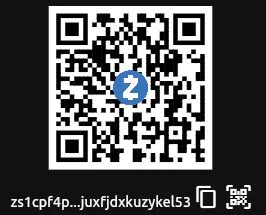
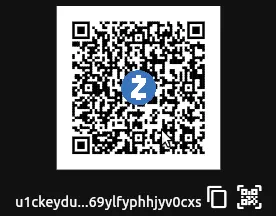
La première chose à remarquer est que la longueur de chaque type d'adresse est différente. Vous pouvez le constater visuellement au nombre de caractères de la chaîne de l'adresse ou en regardant les codes QR associés. À mesure que la longueur de l'adresse augmente, le code QR a tendance à dézoomer pour faire tenir davantage de données dans le carré.
t1goiSyw2JinFCmUnfiwwp72LEZzD42TyYu compte 35 caractèreszs1cpf4prtmnqpg6x2ngcrwelu9a39z9l9lqukq9fwagnaqrknk34a7n3szwxpjuxfjdxkuzykel53 compte 78 caractèresu1ckeydud0996ftppqrnpdsqyeq4e57qcyjr4raht4dc8j3njuyj3gmm9yk7hq9k88cdkqfuqusgpcpjfhwu3plm2vrd32g8du78kzkm5un357r4vkhz4vhxd4yfl8zvszk99cmsc89qv4trd7jzkcs8h6lukzgy25j8cv76p0g603nrrg6yt6cxsh2v8rmkasskd69ylfyphhjyv0cxs compte 213 caractèresLa deuxième chose à remarquer est le préfixe de chaque chaîne d'adresse : les adresses transparentes commencent par t, les adresses sapling par zs et enfin les UA par u1.
Il est important de noter ceci :
Comme expliqué ici, il est possible de créer des UA avec différents récepteurs, c'est-à-dire une combinaison de types d'adresses transparente, sapling et orchard. Outre l'UA complète, voici les plus courantes que vous rencontrerez en pratique :
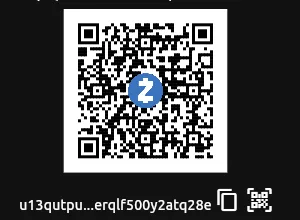
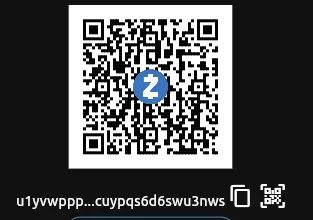
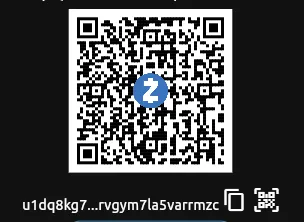
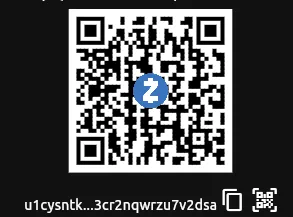
La première chose à noter est que chacune de ces UA provient de la même clé privée ! La deuxième chose à noter est la longueur de chaque type d'UA :
u13qutpuktq026dwczvxmnh8mxdacsjx3kg2rrhzgns8zsty53t9y0hqp5d440zc9w7z7zkkjqw8dq0uuc0mkt883464mq8mkys7l4xjnhylh7u3u02ukknurm5yxerqlf500y2atq28e 141 caractèresu1yvwppp7ann6n3pgkysdu0spvr50w4jf4jwgme3c8x8fp4av59rupgvdd3fddc3f2cwrk3ghs5lxt87ggj8cvjuzcrf4jkejwlu9pc83gk2vtx03ucqcc3ed0furcuypqs6d6swu3nws 141 caractèresu1dq8kg78fgpjsc7dn2ynpdzc8xu99wra0jec4jy30rjqk5frsj62qtgqcu9nn0j8g352phlwprshancgxcuhdcclx0wxtvqylhmuegas7ul8hwnwggy727l05pyujuywtnn4nkfznctaelpkcrqcm9cxhkgv3t9jtrvgym7la5varrmzc 178 caractèresu1cysntkxwt0h4sahp7rhj7u27pgc2ga7685ekf65g0d5ht5glkfm4zkumhvkd2zg2pdrgv3mrwq2x3vw2yl5u7zef3cr2nqwrzu7v2dsa 106 caractèresLa troisième chose à noter est que chaque UA est visuellement légèrement différente ! La force des UA réside dans le choix qu'elles offrent aux utilisateurs finaux. Si un nouveau protocole s'avère nécessaire à l'avenir, les UA seront prêtes.
Ironwood is the shielded pool activated by Network Upgrade 6.3 (NU6.3) on 28 July 2026, at block 3,428,143. It reuses the Orchard protocol and the same receiver structure, so the upgrade changed where shielded payments arrive without introducing a new address format. Ironwood is a pool, not a fourth type of address.
Status: Restricted
Status: Active
Migration depends on your wallet. Activation did not move any coins, and the sources reviewed give no migration deadline. Some wallets migrate automatically, some ask you to start a manual migration, and some have not added Ironwood support. The amount crossing from Orchard to Ironwood is public on the blockchain, while senders and recipients stay private.
In 2026, a critical soundness vulnerability was found in the original Orchard shielded pool and reported responsibly. It concerned the integrity of the money supply, not the confidentiality of shielded transaction data. The flaw was fixed in June 2026, and Ironwood was introduced as part of the network’s response. Here is what is, and is not, established:
A missing constraint in the Orchard proof circuit could, under certain conditions, have let an attacker create invalid shielded value without the proof system detecting it. It did not affect the privacy of funds in any pool.
Public technical reports state that no exploitation has been found or confirmed. A vulnerability that could permit counterfeiting is not evidence that counterfeiting occurred.
Shielded transactions hide amounts and notes by design, so a past exploit of this kind may leave no definitive on-chain evidence. That is why the risk cannot be conclusively ruled out from the chain alone.
Receivers and pools are different things. A unified address holds one receiver per protocol it supports. The Orchard pool is the legacy shielded pool described below; an Orchard receiver is the part of an address that Orchard-compatible wallets use to receive shielded funds. ZIP 316 defines no separate Ironwood receiver type: Ironwood is an Orchard-protocol pool, and ZIP 229 states that address structures and encodings do not change. Existing unified addresses, including the four combinations above, keep working, and an Orchard receiver can receive funds in the Ironwood pool. New payments to it are expected to arrive there, so an Orchard receiver does not by itself mean a payment lands in the original, now restricted, Orchard pool.
Based on ZIPs 229, 257, 258, 316 and 326, the Zcash Foundation’s NU6.2 announcement, Zodl’s Ironwood documentation and BlockSec’s technical analysis of the Orchard bug.
A new pool built on the corrected Orchard protocol, and a turnstile that stops the old pool from paying out more ZEC than verifiably entered it. This keeps total supply auditable whether or not everyone migrates.