Loading...

Series: Formal Verification Series · Part 1 of 3 Audience: complete newcomers. No mathematics, programming, or cryptography background assumed. What you'll leave with: a clear understanding of what it means to prove software correct, why that is fundamentally different from testing it, what a machine-checked proof is, and the precise (and honest) limits of what such a proof can promise.
Most software is trusted because it has been tested: we run it on many inputs and watch it behave. Formal verification asks a bolder question. Can we prove, with mathematical certainty, that a system does what it should for every possible input, including the ones no one ever thought to try? This article builds that idea from the ground up. Intuition first, no symbols until they are earned.
Here is a true story, and it is the reason this series exists.
In 2022, the privacy-focused cryptocurrency Zcash launched a new shielded pool named Orchard, letting people transact with the amounts hidden. For four years it worked flawlessly and passed repeated professional audits. Then, in May 2026, a security researcher reasoning carefully about the underlying mathematics (with help from AI tooling) found a single under-constrained spot in the system's math. That one gap could have let an attacker create an unlimited amount of counterfeit money, and because the amounts were hidden, nobody would have seen it happen. The flaw had been present the entire time.
It was not caught by testing. Every test had passed for four years. It was caught by someone reasoning about the math. And when the team fixed it, they did not simply patch and move on. They wrote a machine-checked mathematical proof, over 2,700 individual theorems, that the replacement could not contain that class of flaw at all.
That is formal verification, and this is what it buys you: not "we tried a lot of cases and they worked," but "we proved it holds for every case." For systems where one missed case is catastrophic (money, aircraft, medical devices, cryptography), that difference is everything.
The blind spot in testing was named decades ago by computer scientist Edsger Dijkstra, and it is still true:
Testing can show the presence of bugs, but never their absence.
If a test passes, you have learned that the system works on that input. You have learned nothing about the inputs you did not try, and the dangerous bugs are almost always in the cases nobody tried.
Imagine you are responsible for a building with a thousand doors, and your job is to guarantee every door is locked at night.
The difference is between sampling reality and proving a property of the design. Testing samples. Formal verification proves. That is the whole idea, and everything else is machinery for doing it rigorously.
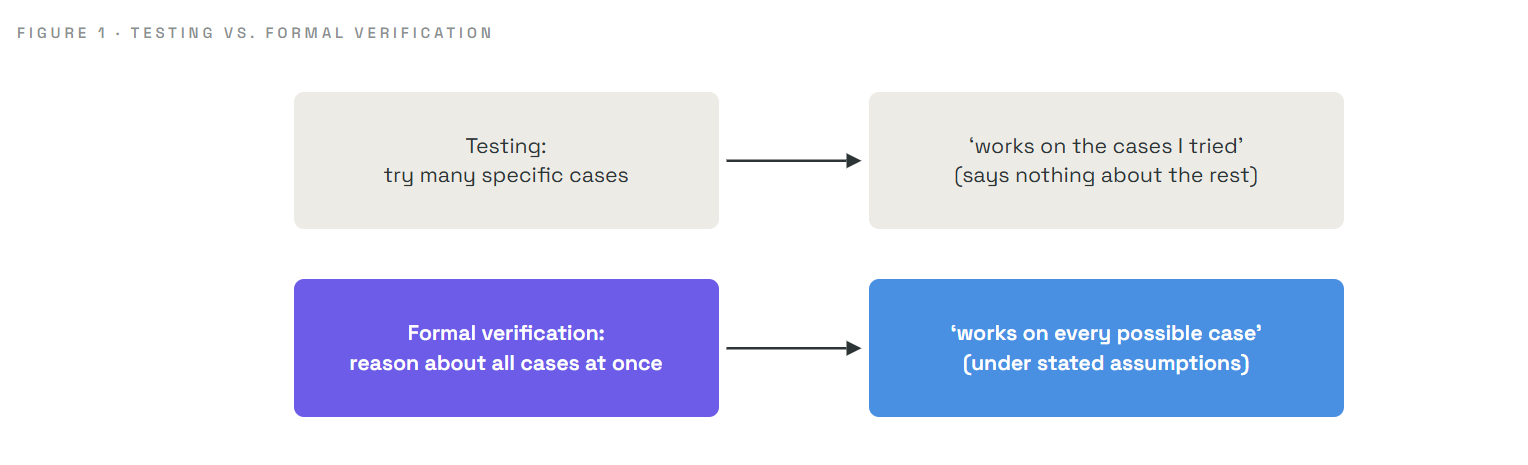
Every formal verification, no matter how advanced, is built from exactly three ingredients. Hold these clearly and the rest is detail.
| Pillar | Plain meaning | Building analogy |
|---|---|---|
| Specification | A precise statement of what "correct" means | "Every door must be locked at night" |
| System | The actual thing being checked (a program, a circuit, a protocol) | The building and its locking mechanism |
| Proof | A rigorous argument that the system always meets the specification | The logical demonstration that pressing "lock" locks all doors |
And a fourth, quieter ingredient makes the whole thing trustworthy:
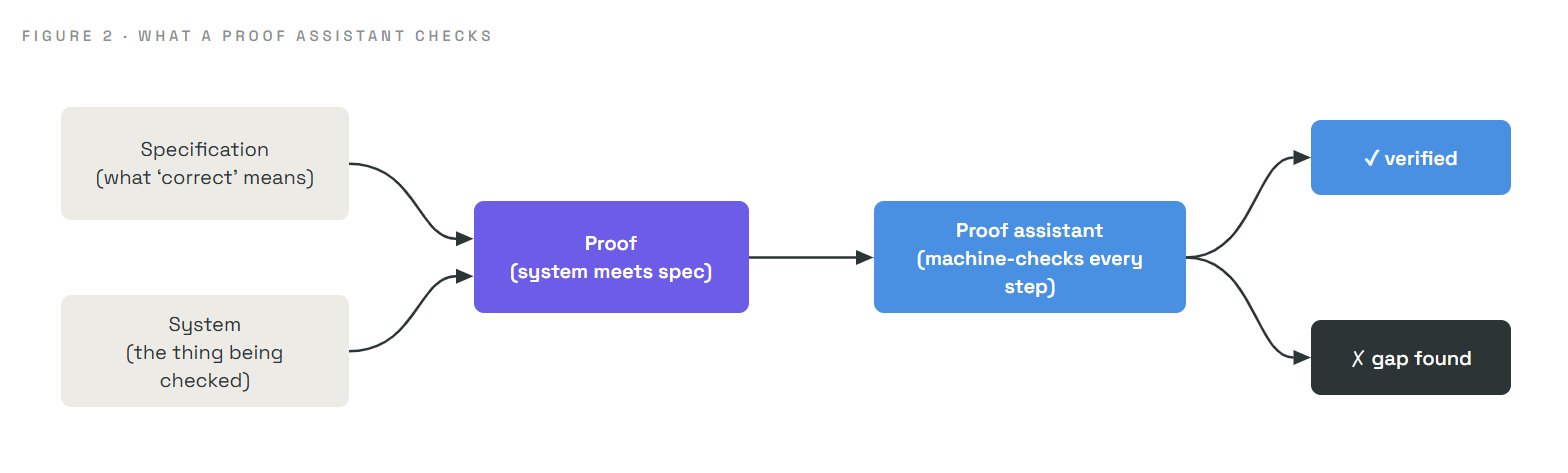
Proof assistants you may hear named include Lean, Rocq (formerly Coq), and Isabelle. They are, in effect, extraordinarily strict logic-checking engines. The Zcash proof in our opening story was written in Lean. Notably, modern AI models are increasingly used to help write these proofs, with humans guiding them, which has shortened efforts that once took years down to weeks. The machine still checks every step, so the speed-up does not cost any certainty.
The word "proof" can feel intimidating, so let's demystify it with a concrete, checkable example. No cryptography, just school arithmetic.
Claim: for every whole number n, the sum 0 + 1 + 2 + ... + n equals n(n+1)/2.
You could test this. n = 5 gives 0+1+2+3+4+5 = 15, and 5 × 6 / 2 = 15. ✓ It matches. Try n = 10: the sum is 55, and the formula gives 10 × 11 / 2 = 55. ✓ (These are computed and confirmed; the claim in fact holds for every n from 0 to 999 when checked directly.)
But testing values, even a thousand of them, never reaches "for every whole number." There are infinitely many. A proof closes that infinite gap in a finite argument, using a technique called induction:
n = 0, the sum is just 0, and the formula gives 0 × 1 / 2 = 0. They agree. ✓k. Now add the next number, k+1. The sum up to k+1 is (sum up to k) + (k+1) = k(k+1)/2 + (k+1). A line of algebra rearranges this to (k+1)(k+2)/2, which is exactly the formula with k+1 in place of k. ✓Since it holds at the start (0) and each step carries it to the next number, it holds for all whole numbers, forever, in one finite argument. That is a proof. A proof assistant does exactly this reasoning, but mechanically verifies that every step, including the "line of algebra," genuinely follows from what came before.
The leap worth absorbing: a proof turns "infinitely many cases" into a finite, checkable argument. That is the superpower testing structurally lacks.
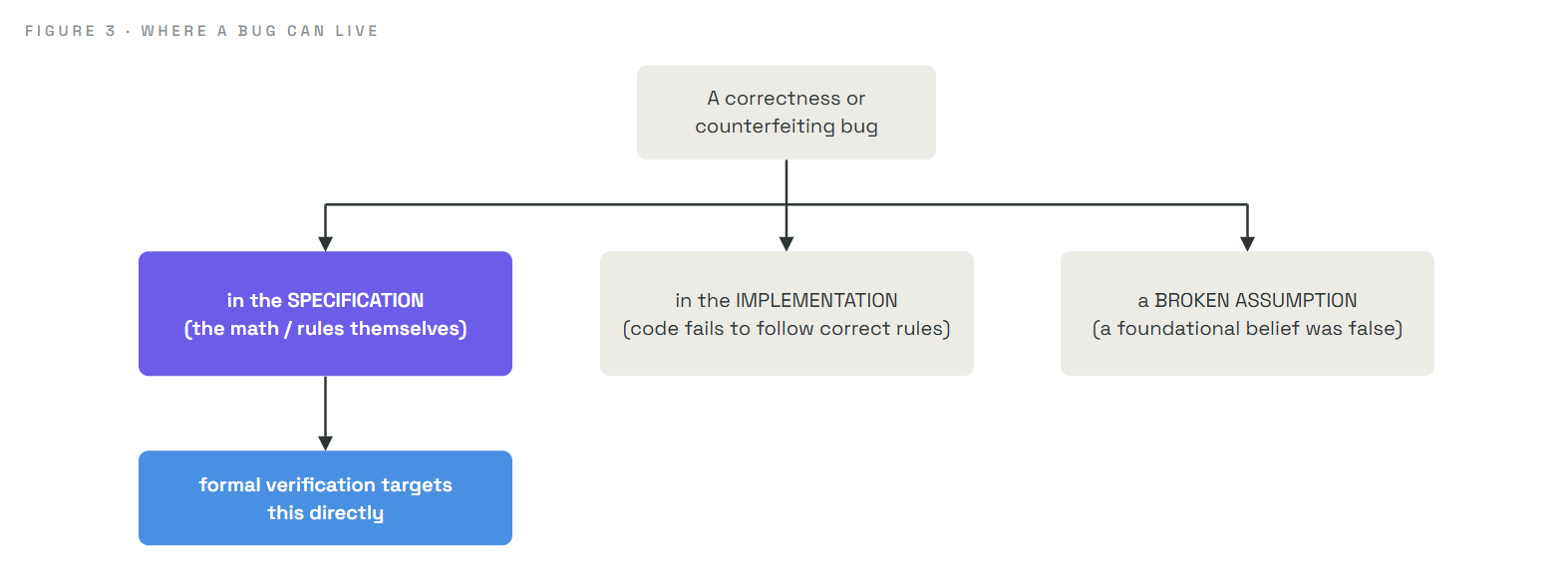
Formal verification is powerful partly because of a clarifying insight about where bugs come from in the first place. Any flaw in a rule-checking system traces to one of three places:
| Source of a bug | What it means | Can we prove it away? |
|---|---|---|
| The specification | The math or rules themselves are wrong (a missing condition, a bad definition) | Yes, directly, this is formal verification's home turf |
| The implementation | The code fails to faithfully carry out a correct specification | Partly; often such failures leave detectable evidence |
| A broken assumption | Something the whole system relies on turns out to be false | No; assumptions are the irreducible foundation |
This taxonomy matters more than it looks, and Parts 2 and 3 turn on it. The deepest, most dangerous bugs, the ones that can hide forever, tend to live in the specification: the mathematical description of what the system is supposed to do. And the specification is exactly what a machine-checked proof can examine directly, all cases at once. That is why serious formal-verification efforts aim there first.
Formal verification is powerful, but its promise is precise, and misunderstanding it leads people astray. So state it carefully:
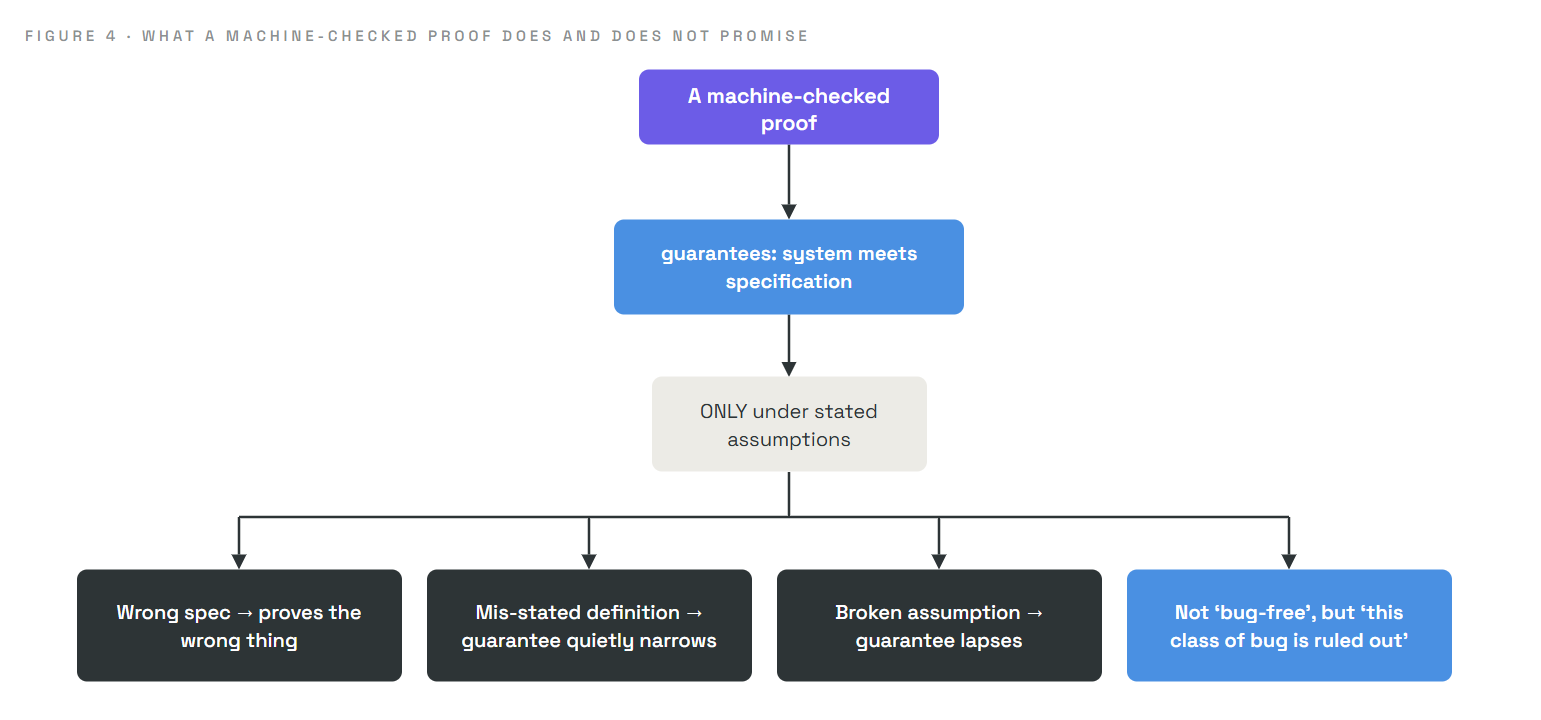
A proof guarantees that the system meets the specification, under stated assumptions. Nothing more.
Four consequences follow, and each one matters:
Far from weakening formal verification, this precision is its strength. It tells you exactly what you are getting. As we will see in Part 3, the Zcash team stating their scope and assumptions plainly ("we proved supply soundness, under these named assumptions, and not privacy") is a model of that honesty.
To keep this readable we simplified. Real specifications are written in precise formal languages, not English sentences; there are several styles of formal verification (interactive theorem proving, model checking, SMT-based methods) suited to different problems; and writing these proofs remains skilled, effortful work even with AI assistance. We also skipped how a proof assistant represents logic internally. None of this changes the core: a specification, a system, and a machine-checked proof that the two agree, under stated assumptions. The detail returns as we need it.
| Term | Plain-English meaning |
|---|---|
| Formal verification | Proving, mathematically, that a system meets a specification for all cases |
| Specification | A precise statement of what "correct behaviour" means |
| System | The actual program, circuit, or protocol being checked |
| Proof | A finite chain of logical steps establishing a claim for all cases |
| Proof assistant / theorem prover | Software (Lean, Rocq, Isabelle) that checks every step of a proof |
| Machine-checked | Verified step-by-step by a computer, not just by human reading |
| Induction | A proof technique: true at the start, and each step carries it to the next |
| Assumption | A condition the proof relies on; if false, the guarantee may not hold |
Does formal verification replace testing? No. They complement each other. Testing catches practical issues and mistaken assumptions cheaply; verification rules out entire classes of bug that testing might never sample.
If it is so powerful, why isn't everything formally verified? It is expensive and demands specialist skill, though AI assistance is lowering that cost. It is reserved for systems where a rare bug would be catastrophic, which is exactly where its cost pays off.
Can a formally verified system still fail? Yes, if the specification was wrong, a definition was mis-stated, an assumption did not hold, or the failure lies outside what was specified. The proof only covers what it claims to cover.
Is a machine-checked proof more trustworthy than a human one? For large, intricate proofs, generally yes. A machine will not overlook a subtle gap or accept a hand-wave, though it still trusts the specification and definitions it was given.
If AI helps write the proof, why trust it? Because the proof assistant checks every step mechanically. The AI proposes steps; the machine verifies them. A wrong step is simply rejected, so AI speeds the work without weakening the guarantee.
You prove that a bank's software "never lets an account balance go negative." A year later, money still goes missing. How could both be true at once? (Answer below.)
The proof guaranteed exactly one property: balances never go negative. Money can go missing in ways that property never addressed, for example a bug that moves funds to the wrong (still non-negative) account, or a flaw in a part of the system that was never specified. The verification did precisely what it promised and nothing more. This is the Section 6 caveat in action: a proof covers the specification, not every conceivable notion of "correct."
Part 2 · The Orchard Bug: we turn to the real 2026 story in full. A privacy system hid amounts using cryptographic proofs, and one under-constrained line in its math meant those proofs could be made to lie, allowing unlimited invisible counterfeiting. We will see exactly what "an under-constrained circuit" means, why this class of bug can hide forever, and why it has happened more than once.
Part of the Formal Verification series for ZecHub.