---
title: "Zaino Indexer"
url: "https://zechub.wiki/zcash-tech/Zaino"
locale: "en"
description: "Zaino is a Rust indexer for the Zcash blockchain. It reads chain data from a Zebra full node. It serves the data wallets, explorers, faucets, and other…"
---
 # Zaino Indexer
## TL;DR
* **Zebra** validates the Zcash chain.
* **Zaino** indexes Zebra's chain data and exposes client-facing APIs.
* **Zallet** is the wallet component in the Z3 stack. In the default Z3 setup, Zallet talks to Zebra directly and does not require the standalone Zaino service.
* The standalone Zaino service is useful when operators need a lightwalletd-compatible gRPC endpoint, a JSON-RPC proxy, or infrastructure for light wallets, explorers, faucets, and similar services.
* Zaino is active infrastructure, but operators should check the official Zaino and Z3 documentation for current deployment details before running it in production.
## Core Explanation
Zaino is a Rust indexer for the Zcash blockchain. It reads chain data from a Zebra full node. It serves the data wallets, explorers, faucets, and other services need, without making Zebra responsible for every client-facing index.
### What Zaino Does
Zaino sits between Zebra and client software. Zebra is the consensus node: it downloads, verifies, and follows the Zcash blockchain. Zaino uses Zebra as its source of chain data, then prepares indexed views that client applications can query efficiently.
This separation keeps the roles clear:
| Component | Role |
|:--|:--|
| Zebra | Full node and validator |
| Zaino | Indexer and client-facing API service |
| Zallet | Wallet service |
| lightwalletd | Older light wallet server that Zaino is designed to replace or complement |
Zaino provides functionality for light clients, full clients or wallets, and block explorers. It gives access to the finalised chain, the non-finalised best chain, and mempool data held by Zebra.
### How It Fits in the Current Zcash Stack
The current Z3 stack is built around Zebra, Zallet, and optional Zaino.
In the default Z3 deployment, Zebra and Zallet run together. Zallet reaches Zebra directly, so an operator running only a local wallet stack does not need to start the standalone Zaino service.
Zaino is added when the operator wants to serve external clients. In Z3, it runs behind the `indexer` Compose profile and adds:
* a lightwalletd-compatible gRPC endpoint for light wallet clients
* a JSON-RPC proxy for explorers, faucets, and service backends
* an indexer database separate from Zebra's chain state
This makes Zaino especially relevant for wallet backends, public infrastructure operators, explorers, faucets, and developers testing services that need indexed Zcash chain data.
### Zaino and lightwalletd
lightwalletd is the original light wallet server. Zaino is the Rust-based successor path for this role. Its goal is to provide compatible APIs where possible so wallets and services can migrate without being fully rewritten at once.
That does not mean every lightwalletd deployment has already moved to Zaino. Operators should treat Zaino as part of the current Zebra-based stack and check the latest project documentation, releases, and service dashboards before choosing what to run.
## Visual / Analogy
Think of the Zcash blockchain as a huge archive of ledger pages.
Zebra is the archivist. It receives every new page, checks that the page follows the rules, and files it in the right place.
Zaino is the reference desk in front of the archive. It reads what Zebra has filed, builds catalogues for quick lookups, and answers visitors fast. Light wallets, explorers and faucets come to this desk with questions such as "what is in this block?" or "which transactions are waiting in the mempool?". The reference desk never decides which pages are genuine. That job belongs to the archivist.
Zallet, in the default Z3 setup, works in the same building and walks straight to the archivist. It has no need for the reference desk.
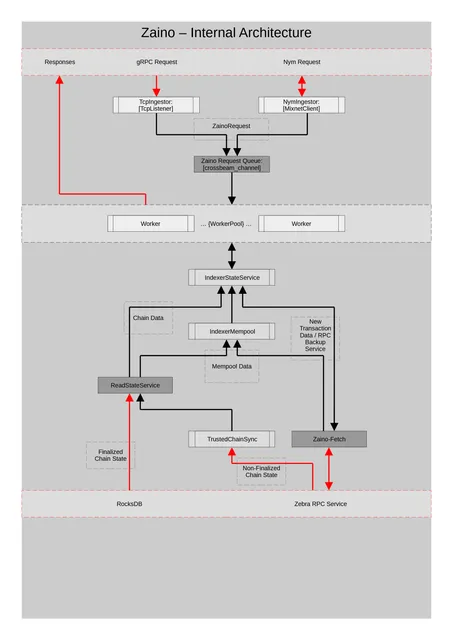
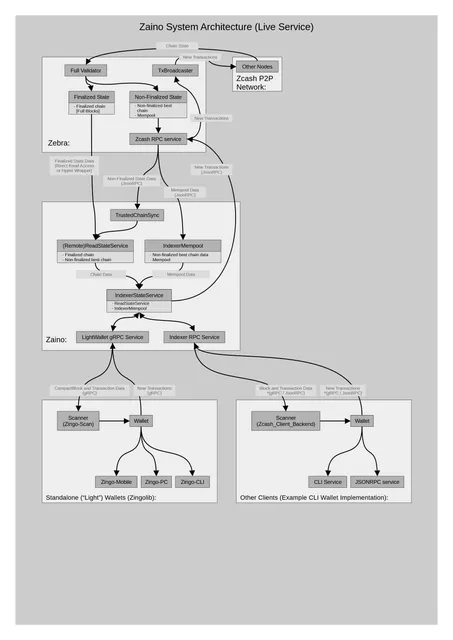
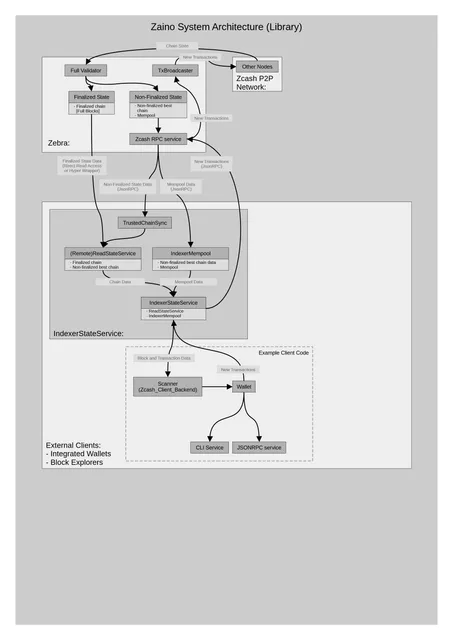
### Some diagrams showing how Zaino works
#### Zaino Internal Architecture
#### Zaino Live Service Architecture
#### Zaino System Architecture
## Deep Dive
### Operator Notes
The easiest authoritative deployment path is the Z3 repository. Z3 includes Zaino as an optional service:
```bash
docker compose --env-file .env. --profile indexer up -d
```
Run the normal Z3 setup first and wait for Zebra to sync before starting dependent services on mainnet or testnet.
Zaino exposes two kinds of network services. The gRPC service is the lightwallet-facing API. The JSON-RPC service is intended for loopback or trusted private networks unless an external layer provides protection. Do not expose an unauthenticated or unencrypted JSON-RPC endpoint to the public internet.
## Common Mistakes
**Treating Zaino as a full node.** Zaino is not the validator. Zebra validates the chain; Zaino indexes data from Zebra.
**Assuming every Z3 deployment needs standalone Zaino.** Zallet can reach Zebra directly in the default Z3 stack. Start Zaino when you need the standalone indexer service for external clients.
**Presenting planned features as already deployed.** Zaino is actively developed, so check the current release notes and docs before describing a feature as available.
**Exposing JSON-RPC carelessly.** Zaino's JSON-RPC interface is for loopback or trusted private networks unless protected by another layer.
## Related Pages
- [Lightwallet Nodes](/zcash-tech/lightwallet-nodes): the servers light wallets connect to, lightwalletd and Zaino, and how to switch between them.
- [Zinder](/zcash-tech/zinder), another Rust indexer, from the Zcash Foundation (alpha)
- [Zebra Full Node](/zcash-tech/zebra-full-node): the node Zaino reads its chain data from.
- [Zallet](/zcash-tech/zallet): the full-node wallet in the Z3 stack.
- [Z3 Stack](/zcash-tech/z3-stack): Zebra, Zallet and the optional Zaino indexer packaged together.
- [Indexer Benchmark: Zaino vs Ztreamer](/zcash-tech/indexer-benchmark-zaino-vs-ztreamer): a reproducible comparison of two lightwallet indexers.
- [Full Nodes](/zcash-tech/full-nodes): an overview of Zcash full node software.
- [Zcash Wallet Syncing](/zcash-tech/zcash-wallet-syncing): why shielded wallets need a sync process at all.
### Resources
* [Zaino GitHub repository](https://github.com/zingolabs/zaino)
* [Zaino releases](https://github.com/zingolabs/zaino/releases)
* [Zaino generated documentation](https://zingolabs.github.io/zaino/)
* [Z3 deployment repository](https://github.com/ZcashFoundation/z3)
* [Zebra documentation](https://zebra.zfnd.org/)
* [Zaino grant and project discussion](https://forum.zcashcommunity.com/t/zingo-labs-accelerates-zcashd-deprecation-with-zaino/48545)
**Last updated:** November 2026