Loading...

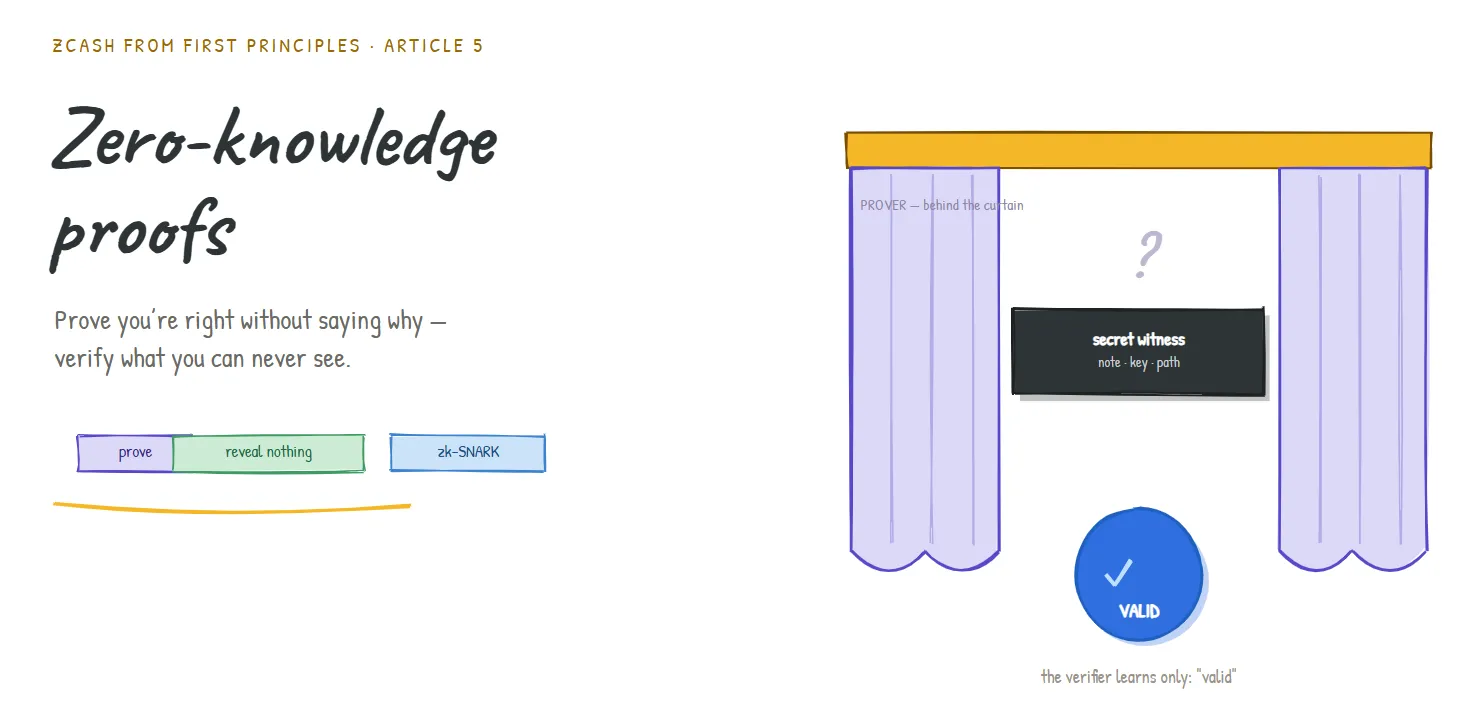
Series: Zcash from First Principles . Article 5 . Zero-Knowledge Proofs (Àdàkọ:Àwọn Àrídájú Ìmòye-Kò-Láti-Onímọ) A fa lori gbogbo ti tẹlẹ article (opin aaye, curves, adehun, Merkle igi), sugbon kọọkan ero ti wa ni ranti bi a ti nilo o. What you'll leave with: an intuitive, correct understanding of what a zero-knowledge proof is, the three guarantees it makes, how arbitrary statements get proven, and what powers Zcash's Sapling and Orchard.
Àpilẹ̀kọ yìí gan-an ni gbogbo àpilẹ̀kọ tá a ti ń sọ̀rọ̀ nípa rẹ̀ ti ń wá.](article-0-shielded-transaction.md) onward we kept saying a payment is validated "behind a curtain," proven correct while revealing nothing. A zero-knowledge proof is that curtain. It's the piece that finally resolves the paradox we opened with: how can the public verify a transaction it isn't allowed to see?
Rántí àríyànjiyàn tó wà nínú Zcash:
àwọn méjèèjì jọ pé wọ́n ń ṣàìdáa síra wọn. ìwádìí fi hàn pé *ó pọn dandan * láti máa wá. ìpamọ́ra * kò gba * wíwá láyè. bí o kò bá lè mú wọn bára wọn mu, o kò lè ní owó àdáni tí ẹnikẹ́ni lè fọkàn tán.
A zero-knowledge proof (ZKP) is the reconciliation. It lets a prover convince a verifier that a statement is true without revealing anything beyond the fact that it's true. No amounts. No identities. No note. Just: "everything here obeys the rules." Let's build the intuition before any machinery.
Proof you know a password, without saying it. A website could verify you know your password by watching you unlock something only the password unlocks, never seeing the password itself. You prove knowledge without disclosure.
The colour-blind friend and two balls. You hold a red ball and a green ball that look identical to your colour-blind friend. You want to convince him they're different colours without telling him which is which. He hides both behind his back, optionally swaps them, and shows you one. You say whether he swapped. If the balls really differ, you're always right. If they were identical, you'd be guessing, right only half the time. After 20 rounds, your unbroken streak convinces him they differ, yet he never learns which ball is red. He's convinced of a fact while learning nothing else. That is zero knowledge in miniature.
The cave. A ring-shaped cave has a magic door at the back that opens only with a secret word. You claim to know the word. To prove it without revealing it: a verifier waits outside while you walk in and picks the left or right passage at random. The verifier then shouts which side they want you to come out from. If you really know the Word, you can always comply (you can open the door to switch sides if needed). If you're bluffing, you may only come out the right side by luck, 50/50 each round. Repeat 20 times and a bluffer's odds of surviving are less than one in a million. If he knows the word, he can always obey (he lè ṣí ẹnu ọ̀nà láti yí ẹ̀gbẹ́ padà bí ó bá pọn dandan). Bí o bá ń ṣe àfòfòfò, o lè jáde lọ́nà tí ó tọ́ nípa oríire, 50/50.
Ìtàn inú ihò náà fi hàn ní rọ̀rọ̀-rọsẹ̀ pé gbogbo ẹ̀rí tí kò ní ìmọ̀ kankan ní láti ṣe.

| Àtìlẹ́yìn | Nínú ìtàn ihò àpáta náà | Nínú Zcash |
|---|---|---|
| Pípé | Tí o bá mọ ọ̀rọ̀ náà, o máa ń jáde ní apá ọ̀tún nígbà gbogbo | Iṣowo to wulo nigbagbogbo n mu ẹri ti a gba wa nigbagbogbo |
| Alaafia | Ó ṣeé ṣe kí bluffer kan mú un | Ìṣòwò ẹ̀tàn (owó èké, ìnáwó méjì) kò lè mú ẹ̀rí tí a gbà wá |
| Onímọ̀ òdo | Olùdánwò kò gbọ́ ọ̀rọ̀ ìkọ̀kọ̀ náà láéláé | Nẹ́tíwọ́ọ̀kì kò kọ́ iye owó, àdírẹ́sì, tàbí àkọsílẹ̀ wo |
Bí èyíkéyìí nínú àwọn nǹkan wọ̀nyí bá kùnà, ètò náà yóò bàjẹ́: kò sí ìmúṣẹ àti àwọn oníṣe rere tí a óò kọ; kò sí àìlálèébù àti àwọn ayédèrú tí yóò tẹ owó; kò ní sí ìmọ̀-òfo àti ìpamọ́ra tí yóò dàwátì.
The cave proves one cute fact. Zcash needs to prove a rich statement: "I know an unspent note in the tree, I'm authorized to spend it, its nullifier is computed correctly, and my inputs equal my outputs." How do we get from balls and caves to that?
Àkọlé náà jẹ́ èrò kan tó so gbogbo ìsọ̀rí yìí pọ̀:
Gbogbo gbólóhùn tí o bá lè fi ìṣirò ṣàyẹ̀wò a lè tún kọ ọ́ padà gẹ́gẹ́ bí àyíká ìṣírò: ẹ̀ka ìkójọ àti ìlọ́po lórí pápá tí ó ní òpin (Apá 1.
Think of the circuit as a list of arithmetic constraints that are all satisfied only if the statement is true. The private inputs that make everything check out, your note, your key, the Merkle path, are called the witness.

This is why we spent Article 1 on finite fields and Article 3 on ZK-friendly hashes: the circuit speaks field arithmetic, so every operation inside the statement (including hashing and the Merkle climb of Article 4) has to be expressed that way. The cheaper each operation is to express, the smaller and faster the proof.
inú ihò àpáta náà nílò ọ̀pọ̀lọpọ̀ ìyípadà. èyí kò ṣeé ṣe fún blockchain, níbi tí ẹ̀rí ti ní láti gbé jáde lẹ́ẹ̀kan tí gbogbo ènìyàn sì yẹ̀ ẹ́ wò, títí láé. àtúnṣe méjì ṣàtúnṣe èyí.
** Non-interactive (the Fiat-Shamir idea).** Dípò tí olùṣàyẹ̀wò kan tó ń gbé ìgbéjàkò lọ́nà àràmàǹdà, olùdánilẹ́kọ̀ọ́ náà máa ń dá "àwọn ìpèníjà láìsí ìdíwọ̀n" sílẹ̀ nípa fífi hash ẹ̀rí tí wọ́n ní tẹ́lẹ̀.
Succinct. Àwọn ètò tó dára jù lọ máa ń mú kí ẹ̀rí náà kéré àti kíákíá láti fi hàn pé òótọ́ ni, láìka bí gbólóhùn náà ṣe tóbi tó sí. Èyí ni apá tó yani lẹ́nu gan-an.
A Groth16 proof (the system Sapling uses) is roughly 192 bytes and verifies in milliseconds, whether the statement it proves is small or enormous. A few hundred bytes can attest to a computation involving many thousands of constraints.
Fi àwọn wọ̀nyí pa pọ̀, o sì rí àkànlò èdè tí wàá rí níbikíbi:
zk-SNARK = zero-kledge Succinct Non-interactive ARargument of Kknowledge. Zero-knowness (kò fi ohunkóhun hàn), succinct (tiny and fast), non-interact (one-shot), argument of knowledge (the prover really knows a valid witness). ìmúninífún: ìmùninífífún, ìmúínífọn, ìmúminífón, ìmóhùnmífón.
Ko si ounjẹ ọsan ọfẹ. Ọpọlọpọ awọn SNARK nilo iṣeto akoko kan ti o ṣe agbejade awọn iṣiro gbangba fun Circuit. Iṣeto naa n ṣe aṣiri aṣiri bi abajade, ati pe aṣiri gbọdọ jẹ ** pa run.** Ti ẹnikẹni ba tọju rẹ, wọn le ṣe ẹri, iyẹn ni pe, ** forge owo ** (biotilejepe, pataki, wọn tun le * ko * fọ asiri).
This leftover secret is nicknamed toxic waste. To dispose of it safely, Zcash ran elaborate multi-party ceremonies where many independent participants each contributed randomness; as long as even one destroyed their piece honestly, the toxic waste is unrecoverable.

Awọn ọna ṣiṣe tuntun yọ ibeere yii kuro patapata, eyiti o jẹ ọkan ninu awọn idi nla julọ ti Zcash ṣe agbekalẹ eto ẹri rẹ ni akoko.
| Apẹrẹ | Ètò ìdánilójú | Eto ti o gbẹkẹle? | A kọ́ ọ lórí |
|---|---|---|---|
| Sprout (àkọ́kọ́) | tete zk-SNARK | Bẹ́ẹ̀ni | ayẹyẹ àtilẹ̀wá |
| Sapling | Groth16 | Bẹ́ẹ̀ni (àjọ "Agbára Tau" + ayẹyẹ Sapling) | BLS12-381 (Àpilẹ̀kọ 2) |
| Orchard (lọ́wọ́lọ́wọ́) | Halo 2 | Ko si eto ti o gbẹkẹle | Pallas / Vesta (Abala 2) |
The march from Sprout to Sapling to Orchard is largely a story about proofs getting smaller, faster, and shedding the trusted setup. Halo 2, used by Orchard, needs no ceremony at all and is built to support recursion (proofs that verify other proofs), which is why Orchard uses the Pallas/Vesta cycle of curves from Article 2: each curve is tuned to verify proofs written over the other.
This closes the biggest loop from Article 0. The "behind the curtain" magic is a zk-SNARK: it proves your transaction satisfies an arithmetic circuit encoding all the rules, while revealing nothing but the single bit "valid."
Zero-knowledge proofs are a deep field and we stayed at intuition level on purpose. We didn't define the precise probability bounds in soundness, the exact form of an arithmetic circuit (R1CS, PLONKish, and so on), how polynomials and commitments turn a circuit into a short proof, or the real internals of Groth16 and Halo 2. The cave is an interactive proof; production systems are non-interactive and far more intricate. None of that changes the core: prove a circuit is satisfied by a secret witness, completely, soundly, and revealing nothing. The machinery is a whole series of its own.
| Àkókò ìgba | Ìtumọ̀ Gẹ̀ẹ́sì lásán |
|---|---|
| Zero-knowledge proof | Jẹ́ kí ẹnìkan gbàgbọ́ pé ọ̀rọ̀ kan jẹ́ òótọ́ láìsí pé ó ń sọ ohunkóhun mìíràn |
| Prover / Verifier | Ẹni tí ó ṣe ẹ̀rí / ẹni tí ó ń ṣàyẹ̀wò rẹ̀ |
| Completeness | Àwọn gbólóhùn òtítọ́ ni a máa ń gbà nígbà gbogbo (láti ọ̀dọ̀ olùjẹ́rìí òtítọ́) |
| Soundness | Àwọn ọ̀rọ̀ èké ni a kọ̀ (àwọn arẹ́nijẹ kò le borí àyàfi nípasẹ̀ oríire) |
| Witness | Àwọn ìkọ̀kọ̀ tí ó sọ gbólóhùn náà di òótọ́ |
| Arithmetic circuit | Gbólóhùn kan tún kọ gẹ́gẹ́ bí àfikún àti ìsọdipúpọ̀ lórí pápá ààlà kan |
| Non-interactive (Fiat-Shamir) | Ẹ̀rí ìbọn kan ṣoṣo kò nílò láti gbé ayé padà-àti-wá |
| Succinct | Ẹ̀rí náà kéré, ó sì yára láti jẹ́rìí láìka ìwọ̀n gbólóhùn náà sí |
| zk-SNARK | Ìjíròrò ìmọ̀ tí kò ní ìbáṣepọ̀ pẹ̀lú ìmọ̀ |
| Trusted setup / toxic waste | Ìṣẹ̀dá paramita ìgbà kan tí àṣírí tó kù gbọ́dọ̀ parẹ́ |
Bí ẹ̀rí náà kò bá fi ohunkóhun hàn, báwo ni wíwo rẹ̀ ṣe lè túmọ̀ sí ohunkóhun? Nítorí pé ètò ìṣirò náà wà lọ́nà tí *ẹni tó bá jẹ́ ojúlówó, tó sì lẹ́tọ̀ọ́ láti jẹ́rìí nìkan ló lè mú ẹ̀rí tó ṣeé fọwọ́ sí jáde.
Ṣé ẹnì kan lè ṣe àdàkàdekè ẹ̀rí? Ìyàtọ̀ kan ṣoṣo ni SNARK tí wọ́n fi àwọn pàǹtírí olóró tó jẹ́ ìgbẹ́kẹ̀lé rẹ̀ pa mọ́; ìdí náà gan-an nìyẹn tí àwọn ayẹyẹ láti pa á run fi ṣe pàtàkì.
Ǹjẹ́ ìmúrasílẹ̀ ìfọkàntán tí kò ṣeé fọkàn tán máa ń tú àwọn ìsọfúnni àdáni mi jáde? Rárá o. Ó máa jẹ́ kí ẹni tó ń jà á lè ṣe owó tuntun, àmọ́ kò ní sọ iye tí wọ́n ná, àdírẹ́sì wọn, tàbí owó tí wọ́n fi ránṣẹ́.
** Kí ló dé tí Zcash fi yí àwọn ètò ìdánilójú padà láti ìgbà dé ìgbà?** Lati gba awọn ẹri ti o kere ju, yiyara ati, pẹlu Halo 2, lati yọkuro iṣeto igbẹkẹle patapata ki o jẹ ki isọdọtun.
Ní inú ihò, kí ló dé tí ó ṣe pàtàkì pé kí olùdánimọ̀ yan ẹ̀gbẹ́ òfo lẹ́yìn tí olùdànimọ̀ bá ti wọlé, dípò kí ó kéde rẹ̀ tẹ́lẹ̀? *
If the verifier announced the side first, a bluffer who doesn't know the word could simply walk into that side from the start and stroll back out, never needing the door. Choosing after the prover commits to a passage forces a bluffer to rely on luck (50/50 per round), which is what makes repeated rounds convincing. This "commit first, then be challenged" ordering is exactly what Fiat-Shamir preserves by deriving the challenge from a hash of the prover's already-committed proof.
Article 6 . The shielded protocol, end to end: the finale. We take every piece, notes, commitments, the note commitment tree, nullifiers, value balance, and the zero-knowledge proof, and assemble a complete Zcash shielded transaction, closing every single loop opened back in Article 0.