Loading...


Series: Zcash from First Principles . Article 4 . Merkle Trees Audience: newcomers. We build on Article 3 (hashing and commitments). If you know what a fingerprint and a commitment are, you're ready. What you'll leave with: an intuitive, correct picture of Merkle trees, how to prove membership without revealing which item you mean, and exactly how this becomes Zcash's note commitment tree.
Article 0 described a "public board" that holds every note ever created and only ever grows. By now you can guess what's pinned to it: commitments (Article 3), the sealed envelopes. But a real board would hold hundreds of millions of them. How does the network store that, verify it, and let you prove your envelope is on the board without pointing to it? The answer is one of the most elegant structures in computer science: the Merkle tree.
Two problems appear the moment you have a giant public list of commitments.
Problem one: integrity at scale. If the list has 300 million entries, how does anyone confirm that not one has been secretly altered? Re-checking 300 million items on every glance is hopeless.
Problem two: private membership. To spend a note (Article 0), you must prove your commitment is genuinely on the board. But if you point at it ("it's entry number 4,201,337!"), you've just deanonymized yourself. You need to prove "my envelope is somewhere on this board" without revealing which one.
A Merkle tree solves both at once. It compresses the entire list into a single fingerprint, and it lets you prove membership with a tiny, position-hiding proof.
Picture a knockout tournament bracket, but instead of players advancing, fingerprints get combined.
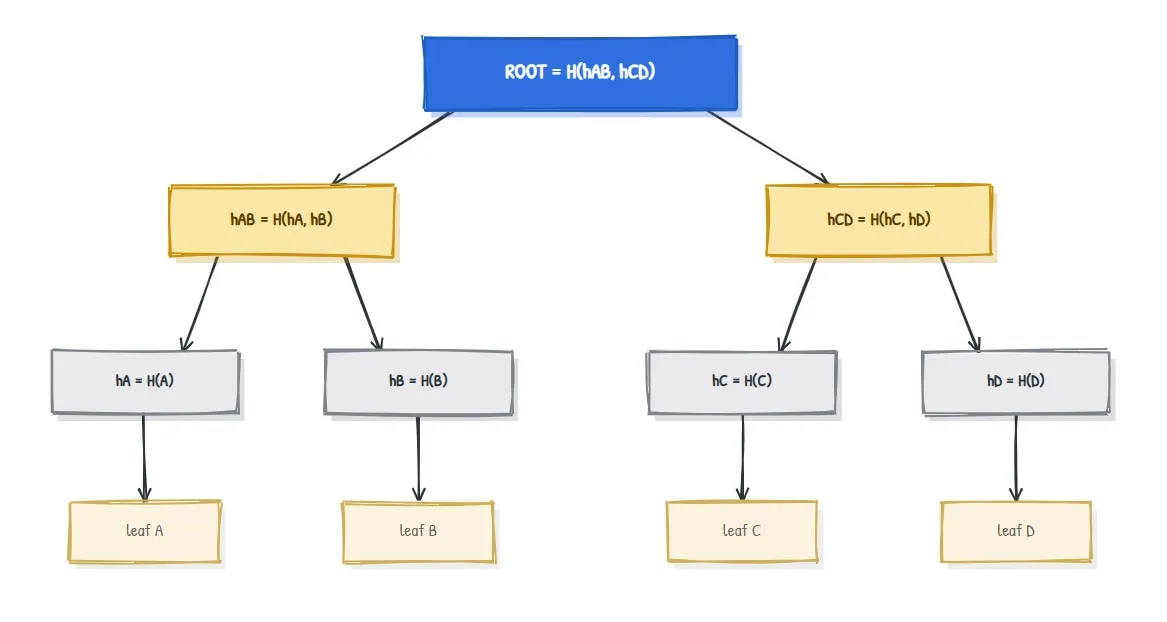
The single most important property follows directly from the avalanche effect (Article 3):
The root is a fingerprint of everything below it. Change any leaf, even by one bit, and its fingerprint changes, which changes its parent, which changes that parent, all the way up. The root changes. So one small root value certifies the integrity of the entire list. That solves Problem one.
Let's build the four-leaf tree above with actual SHA-256 fingerprints over the leaves A, B, C, D (digests shown truncated for readability):
hA = 559aead08264...     hB = df7e70e50215...
hC = 6b23c0d5f35d...     hD = 3f39d5c348e5...

hAB = H(hA , hB) = 63956f0ce48e...
hCD = H(hC , hD) = 98a2fbfddbc7...

ROOT = H(hAB , hCD) = 1b3faa3fcc5e...
Everything is just "hash a thing, then hash pairs of hashes." Nothing more exotic than Article 3, arranged in a tree.
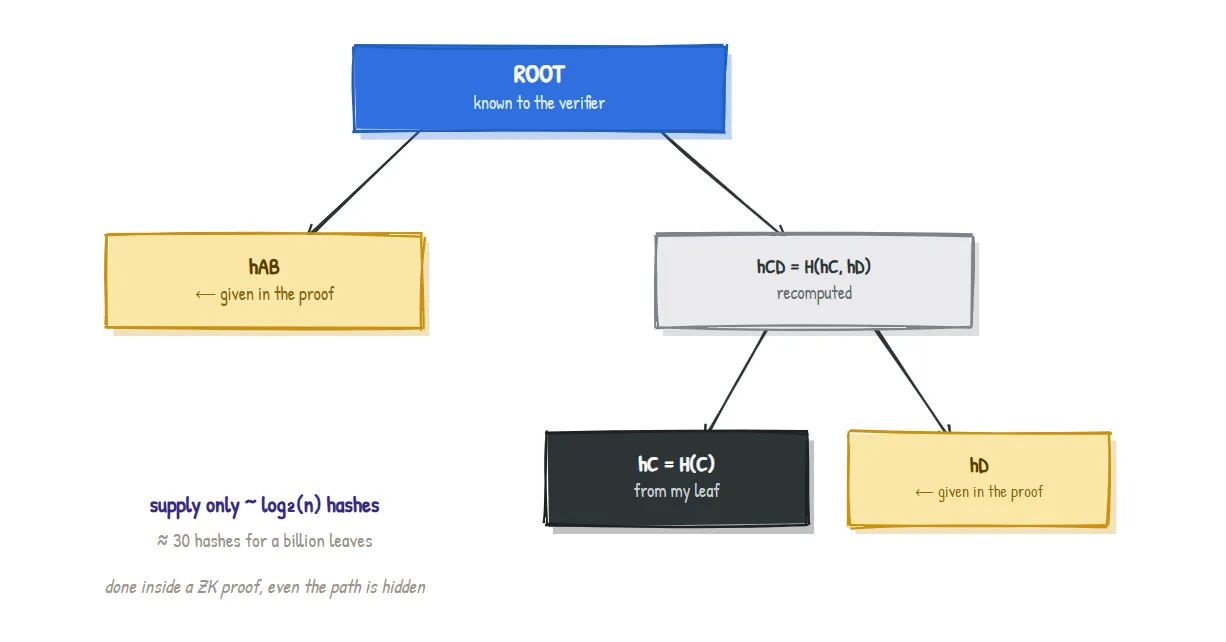
Now Problem two. Say you want to prove that leaf C is in the tree, to someone who only knows the root. You do not hand them the whole tree. You hand them just the fingerprints needed to climb from C to the root, called the authentication path (or Merkle proof):
To prove
Cis in the tree, provide:
- its sibling
hD, and- its uncle
hAB.
The verifier, knowing only the root, recomputes the climb:
step 1:  H(hC , hD)        = hCD       (combine C with its sibling)
step 2:  H(hAB , hCD)      = ROOT?     (combine with the uncle)
Computed for real: this yields 1b3faa3fcc5e..., which matches the root. The leaf is proven to be in the tree.
Two things make this powerful:
n leaves you supply only about log_2(n) hashes. For a billion leaves, that's roughly 30 hashes, not a billion. The proof barely grows as the tree explodes in size.Now we can state precisely what Article 0's "public board" really is:
The note commitment tree is a Merkle tree whose leaves are note commitments. Every time a note is created anywhere in the world, its commitment is appended as the next leaf, and the root is updated.
A few real specifics:
2^(32) (over four billion) notes.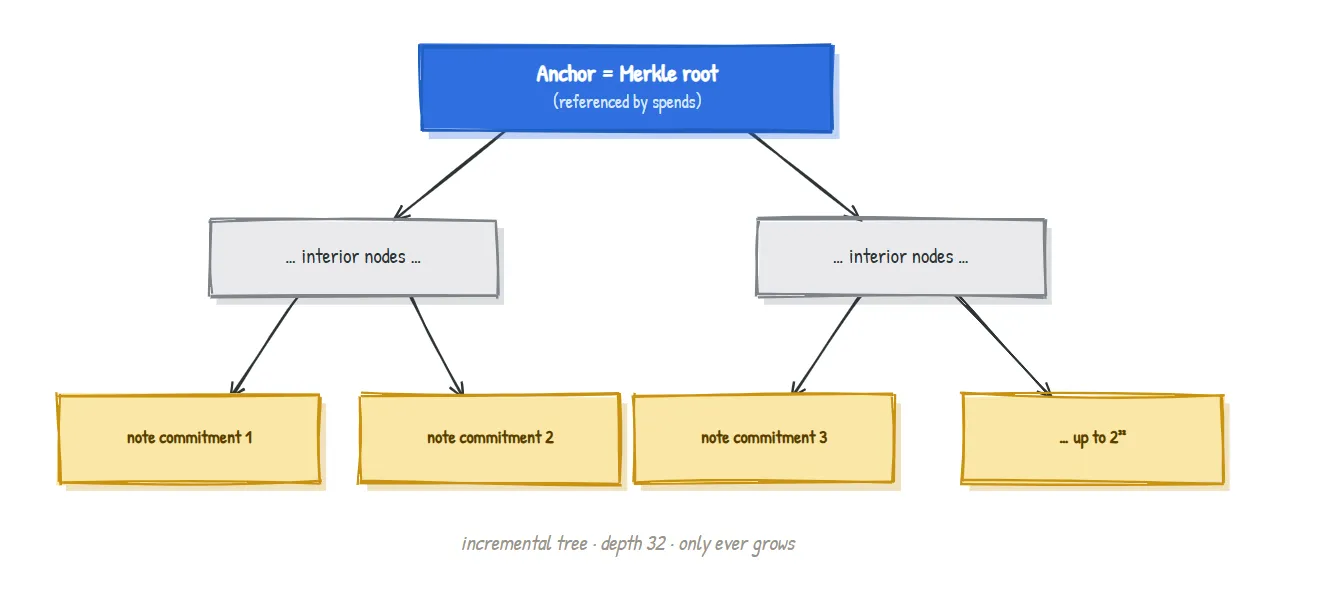
The tree proves a note exists. It does not, by itself, stop you from spending the same note twice. That job belongs to the nullifier set from Article 0: a separate collection of "void tokens." When you spend, you publish the note's nullifier, and the network rejects any nullifier it has seen before.
So the two public structures play complementary roles, and keeping them separate is exactly what severs the link between a note's birth and its death:
| Structure | Question it answers | Updated when |
|---|---|---|
| Note commitment tree | "Does this note exist?" | A note is created (commitment appended) |
| Nullifier set | "Has this note already been spent?" | A note is spent (nullifier published) |
Simplifications, as usual. Real incremental Merkle trees track "frontier" nodes so the root can update without rebuilding everything; the network keeps a window of recent anchors, not just the latest, so wallets aren't broken by every new block; and empty leaves use a defined padding value. We also drew binary trees with neat powers of two. None of this changes the intuition: leaves of commitments, hashed in pairs up to one root, with short membership proofs. The exact bookkeeping returns in the protocol article.
| Term | Plain-English meaning |
|---|---|
| Merkle tree | A tree of hashes; leaves are data fingerprints, parents hash their children |
| Leaf | A bottom node; in Zcash, one note commitment |
| Merkle root | The single top fingerprint summarizing the whole tree |
| Authentication path / Merkle proof | The sibling hashes needed to prove a leaf is in the tree |
| Incremental Merkle tree | An append-only Merkle tree (leaves are only ever added) |
| Anchor | A Merkle root that a spend references as "the tree state I'm proving against" |
| Nullifier set | The separate collection of spent-markers that blocks double-spends |
Why a tree and not just a long list of hashes? A flat list would force you to reveal or process every entry to prove membership. A tree gives you logarithmic-size proofs and a single root for integrity.
Does the verifier need the whole tree? No. The verifier only needs the root plus your short authentication path. That's the whole point.
Why depth 32 specifically? It bounds the tree at about four billion notes, which is ample headroom, while keeping the membership proof (and its in-circuit cost) a fixed, manageable size.
If the root changes with every new note, how do old proofs stay valid? The network remembers a window of recent roots (anchors), so a proof made against a slightly older anchor still verifies. The protocol article makes this precise.
In our 4-leaf tree, suppose an attacker secretly swaps leaf C for a different value but leaves the published root unchanged. What goes wrong for them, and why can't they fix it quietly? (Answer below.)
Changing C changes hC (avalanche effect), which changes hCD = H(hC, hD), which changes ROOT = H(hAB, hCD). So the recomputed root no longer matches the published root, and the tampering is detected. To "fix it quietly" they'd need to find a different C that produces the same hC, which is a hash collision, infeasible by Article 3. Integrity holds.
Article 5 . Zero-knowledge proofs: the crescendo. We've now built notes, commitments, and the tree, and we keep saying "proven in zero knowledge." Article 5 finally explains how you can prove a statement is true, that your note is in the tree, that your nullifier is correct, that money balances, while revealing none of it.
Part of the Zcash from First Principles series for ZecHub. Licensed CC BY-SA 4.0.