Loading...


Series: Zcash from First Principles . Article 1 . Finite Fields Audience: newcomers. We assume only ordinary school arithmetic (adding, multiplying, dividing). No prior cryptography or higher mathematics. What you'll leave with: an intuitive and correct understanding of finite fields, why cryptographers use them, and where they show up inside Zcash.
In Article 0 we met five characters: the note, the commitment, the note commitment tree, the nullifier, and the zero-knowledge proof. We left a loose end hanging: where do all the keys and secret recipes actually come from? They come from numbers. But not the ordinary numbers you grew up with. They come from a special, self-contained number system called a finite field, and almost every piece of cryptography in Zcash is built on top of it.
This article earns that idea slowly. As promised, intuition first. No formulas until they pay for themselves.
Ordinary numbers have a problem for cryptography: there are infinitely many of them, and they leak information.
Think about what happens when a number gets bigger. If I tell you a secret calculation produced 8,142,067, you already know quite a lot: it's a seven-digit number, it's odd, it's "fairly large." Size is a clue. And clues are exactly what a privacy system cannot afford to give away.
Cryptography wants a number system where:
That wish list has a name. It is a finite field. Let's build the intuition for one before we write a single symbol.
You already use a finite field every day. It's the clock on your wall.
On a 12-hour clock, numbers wrap around. Start at 10 o'clock, add 5 hours, and you don't land on "15 o'clock," you land on 3 o'clock. The clock has only twelve positions, and counting past the top simply loops back to the start.
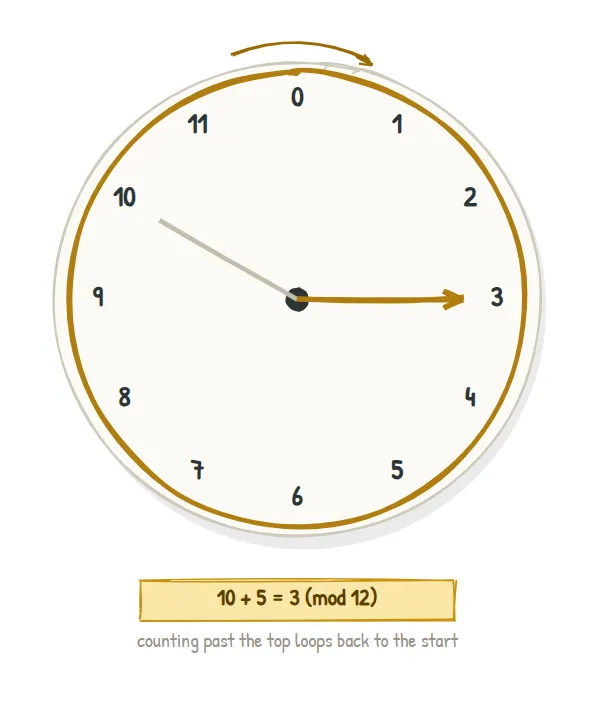
Three things just happened that are the whole point of this article:
This wrap-around arithmetic has a formal name: modular arithmetic. The clock works "modulo 12," written mod 12. Mathematicians prefer to count positions starting from 0, so a "clock mod 12" really has positions 0, 1, 2, ..., 11. A clock mod 7 would have positions 0 through 6.
The one rule: to compute anything "mod p," do the ordinary arithmetic, then divide by
pand keep only the remainder. Example mod 7:5 + 4 = 9, and9leaves remainder2after dividing by7, so5 + 4 = 2 (mod 7).
A clock lets us add. A field is the upgrade: a number system where all four operations behave, including the tricky one, division.
Informally, a field is any collection of "numbers" where you can add, subtract, multiply, and divide (by anything except zero), and all the familiar rules still hold: order doesn't matter for addition or multiplication, brackets can be regrouped, there's a 0 and a 1, and every number has a negative and (except 0) a reciprocal.
The rational numbers are a field. The real numbers are a field. What we want is a finite one.
Here is the headline result, and it is beautiful:
Take the whole numbers
0, 1, ..., p-1and do all arithmetic modp. Ifpis a prime number, the result is a finite field. We write itF_p(read "F sub p").
So F_7 = {0, 1, 2, 3, 4, 5, 6} with clock-style arithmetic mod 7 is a genuine finite field. Let's see it breathe.
Every entry is (row x column) mod 7:
| x | 0 | 1 | 2 | 3 | 4 | 5 | 6 |
|---|---|---|---|---|---|---|---|
| 0 | 0 | 0 | 0 | 0 | 0 | 0 | 0 |
| 1 | 0 | 1 | 2 | 3 | 4 | 5 | 6 |
| 2 | 0 | 2 | 4 | 6 | 1 | 3 | 5 |
| 3 | 0 | 3 | 6 | 2 | 5 | 1 | 4 |
| 4 | 0 | 4 | 1 | 5 | 2 | 6 | 3 |
| 5 | 0 | 5 | 3 | 1 | 6 |
Look at the rows for 1 through 6: each one contains every nonzero value 1..6 exactly once. That "no repeats, nothing missing" pattern is the visible fingerprint of a field.
Division is just "multiply by the reciprocal." In F_7, the reciprocal (or inverse) of a number a is the value a^(-1) for which a x a^(-1) = 1. Reading them straight off the table:
a | 1 | 2 | 3 | 4 | 5 | 6 |
|---|---|---|---|---|---|---|
a⁻¹ | 1 | 4 | 5 | 2 | 3 | 6 |
Check one: 2 x 4 = 8 = 1 (mod 7). So "divide by 2" in F_7 means "multiply by 4." Every nonzero element has a partner. That is what makes F_7 a field.
This is the single most important idea in the article, so let's make it concrete rather than abstract.
Watch what breaks if we naively try to build a "field" mod 6 (and 6 is not prime):
Is there any
xwith2 x x = 1 (mod 6)? Checking all of them:2x0=0, 2x1=2, 2x2=4, 2x3=0, 2x4=2, 2x5=4. The answer1never appears. So2has no reciprocal mod 6. Worse,2 x 3 = 6 = 0 (mod 6): two nonzero numbers multiplied to give zero.
That second sentence is a catastrophe for arithmetic. Two nonzero things multiplying to zero (called a zero divisor) means division is broken, and a system with broken division is not a field. It happens precisely because 6 factors as 2 x 3.
A prime, by definition, has no such factors. So mod a prime, no zero divisors can appear, every nonzero element gets a clean reciprocal, and the structure is a proper field.
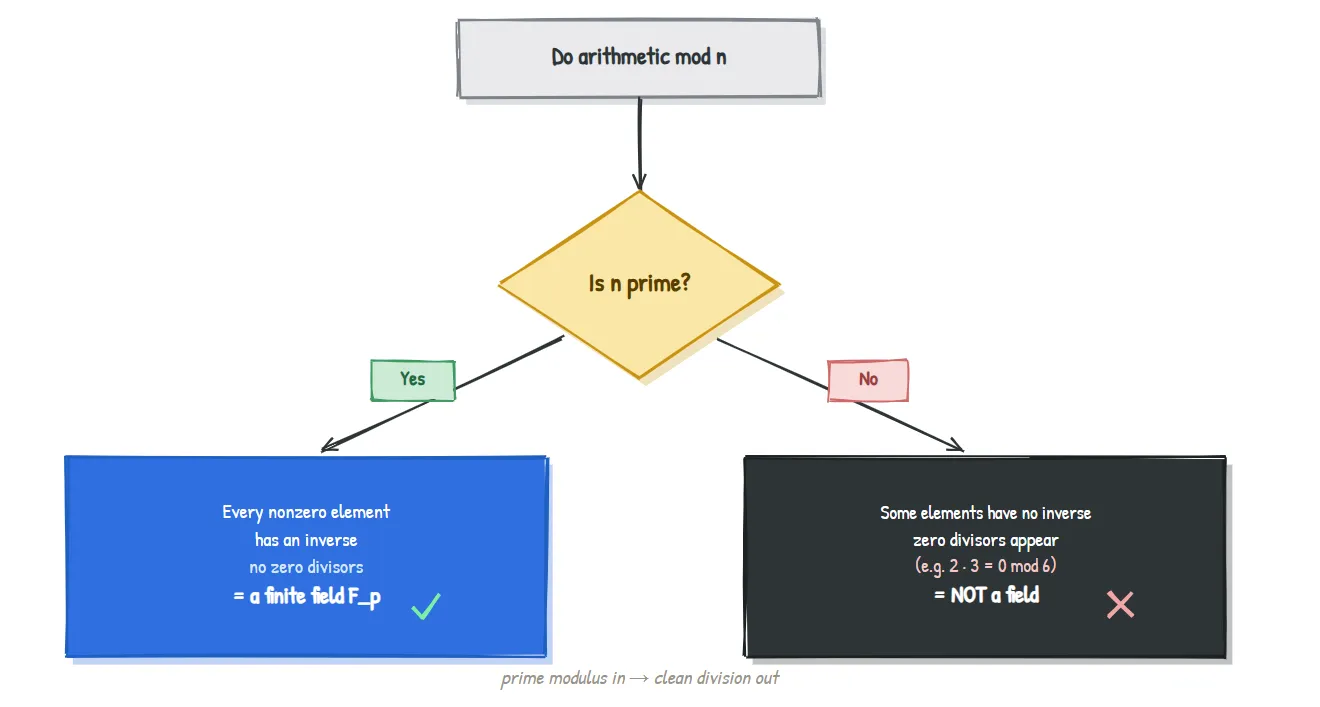
Reusable one-liner for your articles: prime modulus in, clean division out.
We read inverses off a table for F_7, but Zcash's prime has hundreds of digits; no table is possible. There's a classic shortcut, and it's the only formula in this article.
Fermat's Little Theorem says that for a prime p and any nonzero a:
a^(p-1) = 1 (mod p)
Rearrange it (peel off one factor of a) and you get the inverse for free:
a^(-1) = a^(p-2) (mod p)
Test in F_7 (p = 7, so p - 2 = 5): the inverse of 2 should be 2^5 = 32 = 4 (mod 7). And indeed our table said 2^(-1) = 4. Computers raise to large powers extremely fast, so this turns "find the reciprocal" into a quick, exact computation even for gigantic primes.
You do not need to memorize this. You need to know that division in a finite field is a fast, exact operation, which is exactly why cryptographers are happy to build on it.
Putting the intuition together, here is the whole case on one page.
Property of F_p | Why a privacy system wants it |
|---|---|
| Finite | A computer stores any element exactly; no rounding, no overflow, no floating-point fuzz |
| Wrap-around | Erases "size," so a value leaks nothing about how it was produced |
| All four operations work | Cryptographic recipes (keys, commitments, proofs) need genuine algebra, not just counting |
| Choosable size | Pick a 255-bit or 381-bit prime and the field has more elements than there are atoms in the observable universe; guessing is hopeless |
| Exact and deterministic | Two honest parties computing the same thing always get identical results, which proofs depend on |
A finite field is, in one phrase, a perfectly closed, perfectly exact, perfectly huge playground for arithmetic. Everything else in Zcash is built by playing inside it.
You don't have to take "Zcash uses finite fields" on faith. Here's the concrete map (the deeper machinery is for later articles; this is just to show the fingerprints are real).
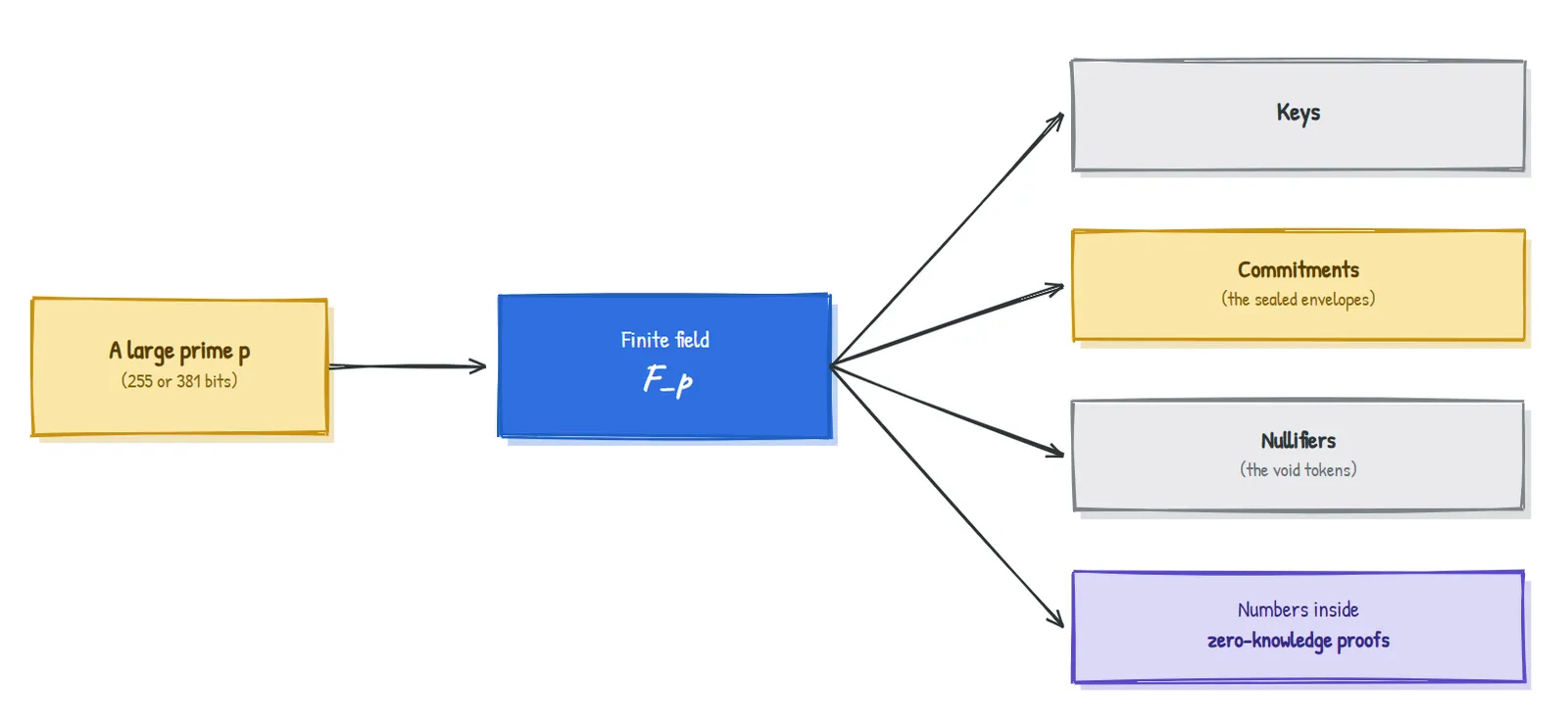
So the answer to Article 0's open question, "where do the secret recipes come from?", begins here: everything starts as arithmetic in a finite field. In the next article we'll take that field and build the actual objects, points on an elliptic curve, that become keys and commitments.
To stay newcomer-friendly we simplified a few true things. Finite fields don't only come in the F_p flavour; you can also build fields with p^n elements (called extension fields), and those matter for the "pairings" that Sapling's proof system relies on. We also skipped the full list of field axioms and glossed over how primes of this size are chosen and validated. None of that changes the intuition you now hold; it refines it. We'll add the precision back, with flags, when a later article needs it.
0..p-1 mod a prime p gives a real field F_p, where you can also divide because every nonzero element has an inverse.2 x 3 = 0 mod 6) and breaks division.a^(-1) = a^(p-2)).| Term | Plain-English meaning |
|---|---|
| Modular arithmetic | Arithmetic that wraps around after reaching a fixed value, like a clock |
| mod p | "Divide by p and keep the remainder" |
| Field | A number system where add, subtract, multiply, and divide all work |
Finite field F_p | The numbers 0..p-1 with arithmetic done mod a prime p |
| Inverse (reciprocal) | The element a^(-1) with a x a^(-1) = 1; "dividing by a" means multiplying by it |
| Zero divisor | Two nonzero values whose product is zero; the thing that ruins composite moduli |
| Prime | A whole number greater than 1 with no factors except 1 and itself |
Why not just use ordinary integers or decimals? Decimals round and drift; integers grow without bound and leak size. Finite fields are exact, bounded, and size-blind, which cryptography requires.
Does "wrap around" lose information? On purpose, yes. Erasing the size of intermediate values is a feature, not a bug, for privacy.
Is a bigger prime always more secure? Loosely, a bigger field means more possible values and harder guessing, but security depends on the whole construction, not the field size alone. Later articles make this precise.
Why these specific primes (255-bit, 381-bit) in Zcash? They're chosen so the curves built on them have the right structure and efficiency for the proof system. That "right structure" is the subject of the next two articles.
In F_7, what is 5 - 6? (Remember: stay inside {0,...,6} by wrapping around.) (Answer below.)
5 - 6 = -1, and -1 wrapped into F_7 is 6 (because 6 + 1 = 7 = 0). So 5 - 6 = 6 (mod 7). Subtraction never leaves the field; it just wraps the other way.
Article 2 . Elliptic curves: we take the finite field we just built and use it to draw a strange kind of curve whose points can be "added" together. Those points become Zcash's keys and commitments, and they hide a one-way trapdoor that makes the whole privacy system possible. Intuition first, as always.
Part of the Zcash from First Principles series for ZecHub. Licensed CC BY-SA 4.0.
| 4 |
| 2 |
| 6 | 0 | 6 | 5 | 4 | 3 | 2 | 1 |