Loading...


Series: Zcash from First Principles . Article 0 . The Anchor Audience: complete newcomers. No cryptography, no blockchain background, and no mathematics assumed. What you'll leave with: a correct mental model of how Zcash hides who paid whom, and how much, while still letting the whole world verify that no money was forged or spent twice.
Every later article in this series zooms into one piece of the machine you're about to meet. So if a word here feels hand-wavy, good. That's a promise that we'll come back and earn it properly.
Imagine your bank statement were nailed to a wall in the town square. Forever. Anyone (your landlord, your employer, a stranger, a future employer, a government) could read every rent payment, every medical bill, every donation, every coffee, and trace exactly who you sent money to and who sent money to you.
That is not a dystopian hypothetical. That is roughly how Bitcoin works.
Bitcoin is often called "anonymous," but it isn't. It's pseudonymous: your name isn't on the ledger, but every transaction, amount, and link between addresses is public and permanent. The entire field of "chain analysis" exists to peel back that thin pseudonym and tie addresses to real people. Once one of your addresses is linked to you, your financial history unspools.
Zcash was built to answer a deceptively hard question:
Can we have money that is completely private, hiding sender, receiver, and amount, while still letting anyone verify that the rules were followed?
Those two goals fight each other. A public ledger is verifiable because everyone can see it. Privacy means nobody can see it. So how can the public verify something it isn't allowed to look at?
Resolving that paradox is the entire story of this series. Let's begin.
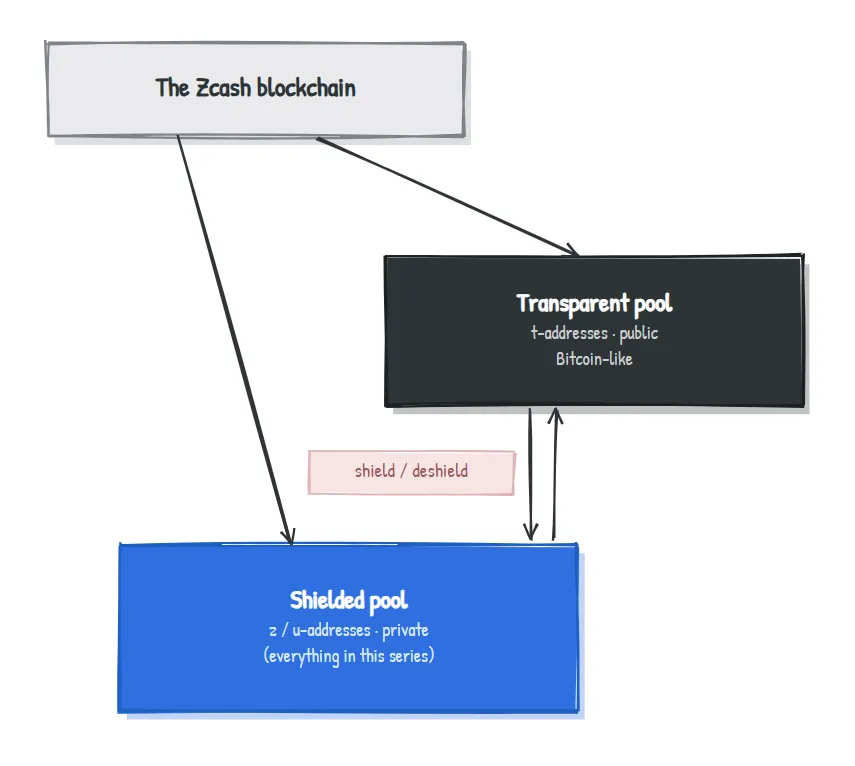
Before anything else, clear up a common misconception: Zcash is not "the private coin." It's a coin that offers privacy as an option. It actually started life as a fork of Bitcoin, and it carries two parallel systems on the same blockchain.
| Transparent world | Shielded world | |
|---|---|---|
| Privacy | Public, just like Bitcoin | Private |
| Addresses start with | t... | z... or u... |
| Sender / receiver / amount | Visible to everyone | Hidden from everyone |
| Underlying tech | Bitcoin-style public ledger | Cryptographic commitments + zero-knowledge proofs |
Money can even cross the border between them: moving funds into the shielded world is called shielding, and moving them back out is deshielding.
The transparent world is "Bitcoin you already roughly understand." It's the shielded world that contains all the beautiful cryptography, and that's the only world this series cares about.
Here's the single mental picture to carry through the rest of the article. We'll return to it constantly.
Picture one enormous public bulletin board that everyone on Earth can see at all times.
Receiving money means someone pins a sealed, opaque envelope to the board. Inside the envelope is how much money it holds and a secret that only the recipient can read, because the envelope is locked to that recipient's personal key. The whole world sees that an envelope appeared. Nobody but the owner can see what's inside.
The board only ever grows. Envelopes are never torn down or erased. New ones are pinned on top, forever.
Spending money means stepping behind a curtain, proving "I own one of the unspent envelopes on this board, and I'm allowed to open it", then dropping a unique void token into a public "spent" bin and pinning new envelopes for whoever you're paying.
That little ritual (pin a void token, pin new envelopes, all from behind a curtain) is a Zcash payment. Everything else is detail.
Now let's give those props their real names.
These five terms are the entire vocabulary of shielded Zcash. Learn them as a story, not as a glossary, and they'll stick.
| In the story | Real Zcash term | What it actually is |
|---|---|---|
| The envelope's contents (amount + owner + a secret) | Note | The private "coin": a chunk of value belonging to someone |
| The sealed, opaque envelope on the board | Note commitment | A cryptographic seal proving an envelope exists while hiding what's inside |
| The bulletin board itself | Note commitment tree | An append-only record of every note ever created |
| The void token in the "spent" bin | Nullifier | A unique marker meaning "this note has now been spent" |
| The "behind the curtain" magic | Zero-knowledge proof | A proof that the whole spend is valid, revealing none of it |
If you remember nothing else from this article, remember this table. Everything that follows is just why each piece has to be shaped the way it is.
This is the part most explainers skip, and it's exactly the part that separates "I memorized some words" from "I understand the design." Each of the five pieces exists to solve one specific problem.
An ordinary envelope can be steamed open. A cryptographic note commitment cannot. Think of it as a magically sealed, fully opaque envelope with two superpowers:
How can a seal do both at once? That's a real and answerable question. It's the subject of Article 3 (commitments). For now, accept the envelope as magic and keep moving.
When you spend a note, you publish its nullifier, the "void token." This token is computed from the note itself and your secret key. That recipe buys three properties simultaneously, and each one matters:
That third property is the heart of Zcash privacy, and it deserves its own section below.
Everything happens behind a curtain, and what you hand the world afterward is a zero-knowledge proof, a kind of unforgeable certificate. It silently attests to all of this at once:
The miracle is that the proof reveals none of those facts. Not the amount, not the addresses, not which envelope. It only convinces you that every statement above is true. How that's even possible is Article 5 (zero-knowledge proofs), the crescendo of the series.
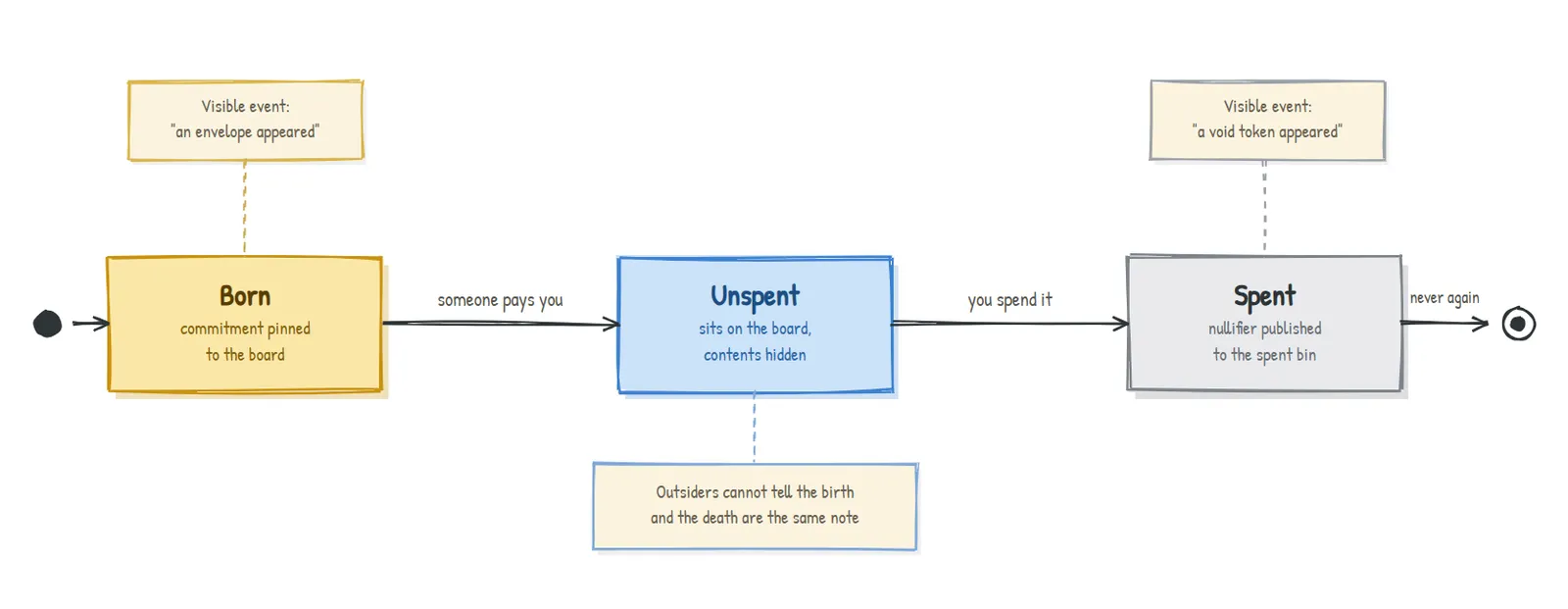
A note is born, it lives on the board, and eventually it dies, and crucially, its birth and its death look unrelated to anyone watching.
Let's watch Alice pay Bob, with every public and private step labelled.
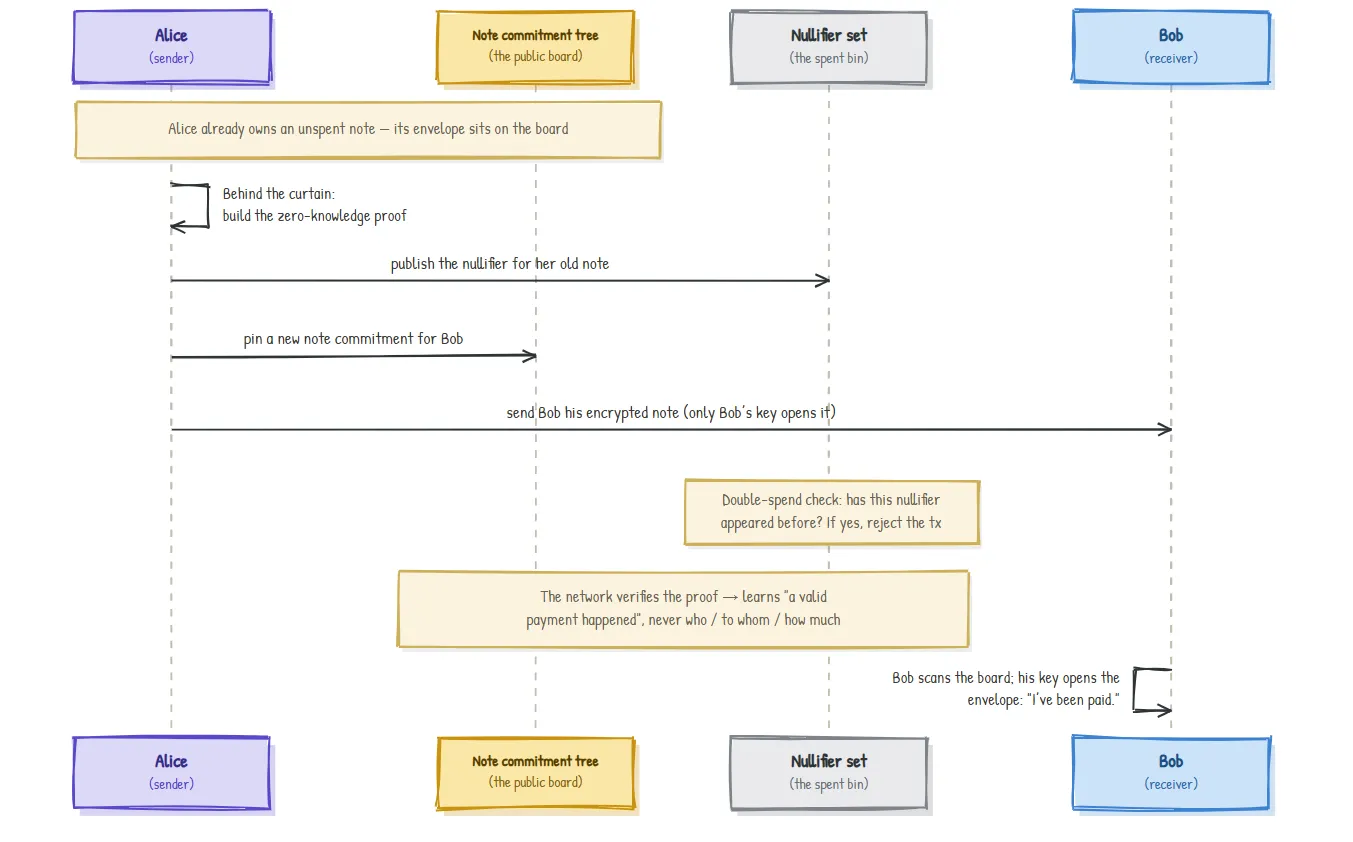
Notice the asymmetry that makes the privacy work:
How does Bob even know he was paid? His note is encrypted to his key. He continuously scans the board and only his envelopes pop open for him, like having the one key that fits a specific set of locks. The machinery behind this is viewing keys, a later topic.
| Fact about the payment | Visible to the public? |
|---|---|
| That a shielded transaction occurred | Yes |
| That it obeyed all the rules (no forgery, no double-spend) | Yes (via the proof) |
| Who sent the money | Hidden |
| Who received it | Hidden |
| How much was sent | Hidden |
| Which earlier note was spent | Hidden |
This is the resolution of the paradox from Section 1. The public verifies the rules, not the contents. Verification and privacy stop fighting, because the zero-knowledge proof lets you check the former without touching the latter.
If you understand this one idea, you understand why Zcash is private. Read it slowly.
So an outside observer sees a stream of envelopes appearing and a stream of void tokens appearing, but cannot match them up. They can't say "the void token dropped today corresponds to the envelope pinned last March." The link exists only inside the secret knowledge of the note's owner, and the zero-knowledge proof confirms the link is valid without revealing it.
That broken link is the thing chain-analysis firms feast on in Bitcoin, and the thing Zcash deliberately severs.
Test your intuition: If nullifiers were instead computed only from the note (no secret key involved), which of the three properties in Section 5 would break, and why would that quietly destroy privacy? (Answer at the end.)
This is a mental model, not the spec. To keep it newcomer-friendly we've quietly simplified several real things: Zcash has had multiple shielded designs (Sprout, then Sapling, now Orchard); real transactions can spend and create several notes at once; "the board" is technically a specific kind of tree, not a literal pinboard; and value balance is enforced with some additional cryptographic bookkeeping. None of those details change the story you just learned; they refine it. We'll add the precision back, one article at a time, and flag clearly whenever we do.
Good educational content earns trust by saying what it left out. This section is that promise.
Every "we'll come back to this" above is a thread. Here's where each one gets tied off:
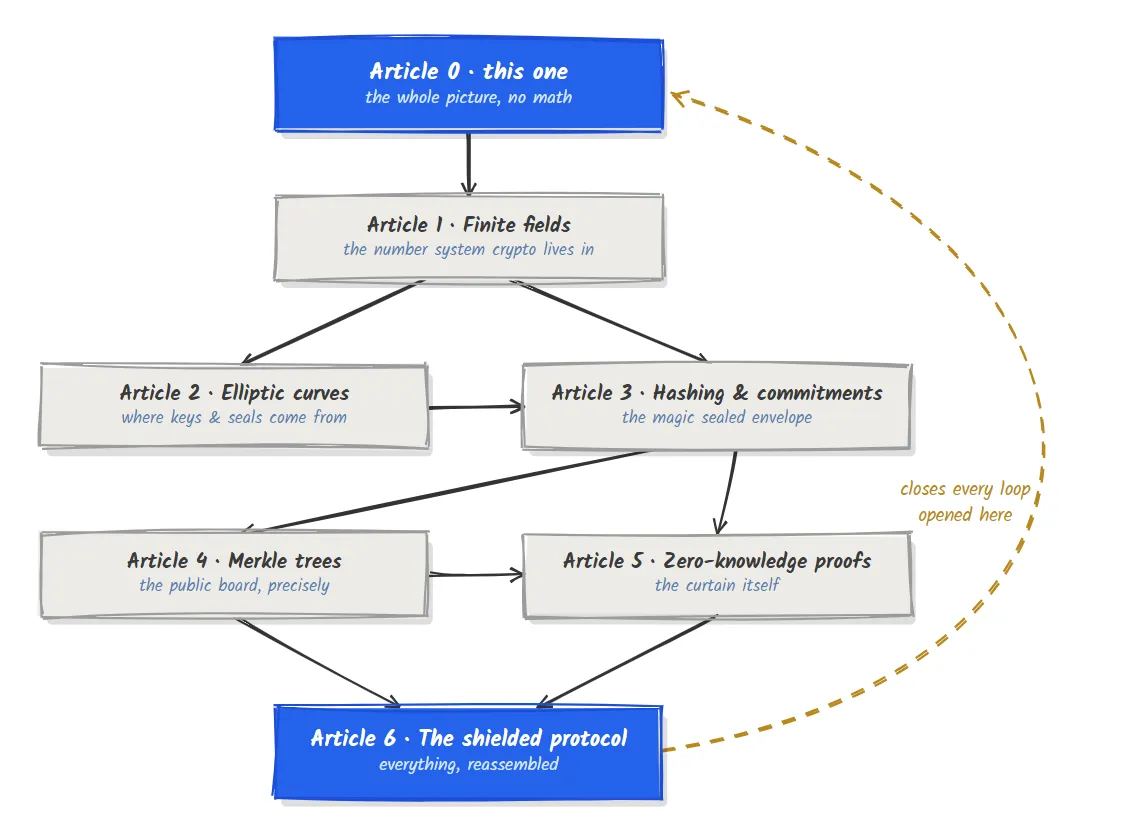
| Loose end from this article | Where it's resolved |
|---|---|
| How can a sealed envelope be both hiding and unforgeable? | Article 3: commitments |
| Where do the keys and secret recipes come from? | Articles 1 & 2: fields and curves |
| What is "the board," exactly? | Article 4: Merkle trees |
| How can you prove something while revealing nothing? | Article 5: zero-knowledge proofs |
| How do all five pieces snap together in real Zcash? | Article 6: the shielded protocol |
You now hold the map. The rest of the series fills it in.
| Term | Plain-English meaning |
|---|---|
| Note | A private unit of value, Zcash's equivalent of a coin or bill |
| Note commitment | A cryptographic seal that proves a note exists without revealing it |
| Note commitment tree | The append-only public record of all note commitments |
| Nullifier | A unique "spent" marker published when a note is used, preventing double-spends |
| Zero-knowledge proof | A proof that a statement is true while revealing nothing beyond its truth |
| Shielding / deshielding | Moving funds into / out of the private shielded world |
| Viewing Key | The key that lets the owner detect and read notes addressed to them |
Is Zcash always private?
No. Privacy applies to the shielded world (z.../u... addresses). Transparent (t...) transactions are public, like Bitcoin.
If everything is hidden, what stops someone printing free money? The zero-knowledge proof. It mathematically forces every transaction's outputs to be backed by real, unspent inputs, while keeping the amounts secret.
Can the same note be spent twice? No. Spending a note publishes its nullifier; a second attempt would publish the identical nullifier, which is already in the "spent" bin, so the network rejects it.
Can outsiders link a sender to a receiver? No. The commitment (note's birth) and the nullifier (note's death) can't be matched by anyone without the owner's secret knowledge.
If the nullifier were computed only from the note, with no secret key, then anyone could compute it, breaking property #1 (only the owner can spend). Worse, the nullifier would now be derivable straight from public information about the note, which could let observers link the nullifier back to its commitment, breaking property #3 and quietly unravelling the privacy of the whole system. The secret key is what makes the void token both exclusively yours and unlinkable.
Article 1 . Finite fields: the strange, beautiful number system where arithmetic "wraps around," and the reason every piece of cryptography in this series lives there. We'll start, as always, with intuition, no formulas until they're earned.
Part of the Zcash from First Principles series for ZecHub. Licensed CC BY-SA 4.0.