Loading...

Zcash did not launch an ETF. Grayscale did, by converting a fund it has run since 2017. Zcash is a protocol — it has no company, treasury or board that could issue a fund. Grayscale is an independent asset manager that buys ZEC on the open market like anyone else.
That distinction is the single most misread thing about ZCSH, and it is where this page starts. On 25 August 2026 the fund began trading on NYSE Arca as The Zcash ETF, the first US spot Zcash exchange-traded product, and it is now one of the larger single holders of ZEC in existence.
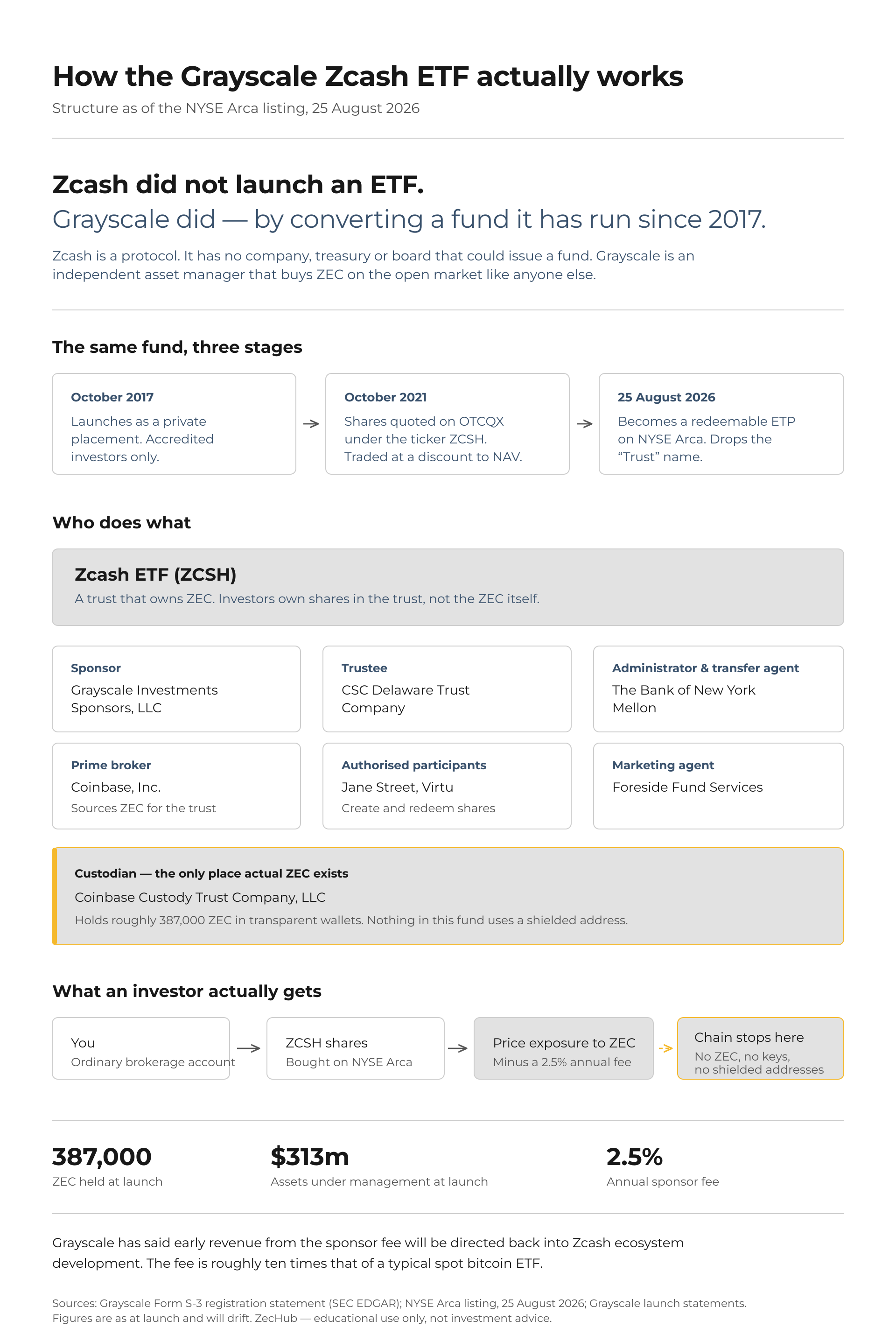
| When | What changed |
|---|---|
| October 2017 | Launches as a private placement, accredited investors only |
| October 2021 | Shares quoted on OTCQX under the ticker ZCSH, trading at a discount to NAV |
| 25 August 2026 | Becomes a redeemable ETP on NYSE Arca and drops "Trust" from the name |
The 2026 step is not cosmetic. An OTC-quoted trust has no redemption mechanism, so its shares can drift to a premium or discount against the value of the assets behind them, sometimes severely — which is exactly what happened between 2021 and 2026. An exchange-traded product with working creation and redemption has an arbitrage path that keeps the share price tethered to net asset value. Changing from one to the other changes how the thing behaves as a security.
| Role | Party |
|---|---|
| Sponsor | Grayscale Investments Sponsors, LLC |
| Trustee | CSC Delaware Trust Company |
| Administrator and transfer agent | The Bank of New York Mellon |
| Prime broker | Coinbase, Inc. — sources ZEC for the trust |
| Authorised participants | Jane Street, Virtu — create and redeem shares |
| Marketing agent | Foreside Fund Services |
| Custodian | Coinbase Custody Trust Company, LLC — the only place actual ZEC exists |
No single one of these parties is the fund. The structure is the arrangement between them, which is what the diagram above sets out. Several of these roles were missing or garbled in news coverage at the time of listing; the list here follows Grayscale's Form S-3 registration statement on EDGAR.
Only Authorized Participants — registered broker-dealers under agreement with the Sponsor — can create or redeem shares, and only in blocks of 10,000, called Baskets. An ordinary investor never touches this machinery; they buy and sell existing shares on the exchange like any other listed security.
The mechanism is currently cash, not in-kind. An Authorized Participant deposits cash into, or receives cash from, a cash account, and a third-party liquidity provider is what actually obtains or disposes of the ZEC. The registration statement also describes an in-kind process, in which an Authorized Participant would deposit ZEC directly with the Trust or receive ZEC from it — but it states plainly that "In-Kind Regulatory Approval has not been obtained," and may never be.
So under the cash process, ZEC changes hands between the liquidity provider and the market, never between the investor and the Trust. Nobody in the retail path touches a Zcash address.
The sponsor fee is 2.5% a year, as at listing. It accrues daily as a percentage of net asset value and is, in the filing's words, "payable in ZEC to the Sponsor daily in arrears."
The consequence is structural rather than incidental. The fee comes out of the fund's ZEC, so the amount of ZEC backing each share declines a little every day. A share is not a fixed quantity of ZEC held indefinitely; it is a claim on a slowly shrinking one. Anyone comparing long-term ZCSH exposure against simply holding ZEC needs that in the comparison.
For context, 2.5% is roughly ten times the fee on a typical spot bitcoin ETF. Grayscale has said early revenue from the sponsor fee will be directed back into Zcash ecosystem development.
A share is exposure to the price of ZEC. It is not ZEC.
A shareholder cannot send a shielded transaction, cannot attach a memo, cannot hold a unified address, and cannot self-custody. None of the properties that distinguish Zcash from other assets are available through the wrapper — the wrapper conveys price and nothing else. For an investor whose goal is exposure inside a brokerage or retirement account, that is exactly the point. For anyone whose interest in Zcash is the privacy, the ETF is not a substitute for a wallet, and the two are not really alternatives to one another.
There is a further irony in the structure, and it is the sharpest thing on this page. Coinbase Custody holds the Trust's ZEC in transparent addresses, not shielded ones. The fund's holdings are visible on chain, traceable to the custodian, and observable in real time by anyone who cares to look. Nothing in this fund uses a shielded address.
That is not an oversight. Regulated fund infrastructure is built around audit and attestation, and a shielded balance is precisely what an auditor cannot independently verify. Coinbase's own support reflects the same asymmetry: it will receive ZEC sent from a shielded address, but it does not send ZEC to one.
So the largest institutional holder of a privacy asset holds it in the one form that has no privacy. This point is sourced to reporting rather than to the filings — the S-3 describes custody of the Trust's private keys but does not characterise address types — and is stated here with that caveat.
At listing on 25 August 2026 the fund held approximately 387,000 ZEC, with around $313 million under management.
For a longer view: as of 30 September 2025 the filing states the Trust held roughly 2.4% of circulating ZEC. Both numbers drift — the first with the ZEC price and with creations and redemptions, the second as the fee is paid out of the holdings — so take a current figure from the most recent filing or the fund's own daily disclosure rather than from this page.
All primary, all on EDGAR under CIK 1720265 unless noted.
Figures are as at the dates given and will drift. Checked 30 September 2026. Educational use only, not investment advice.